

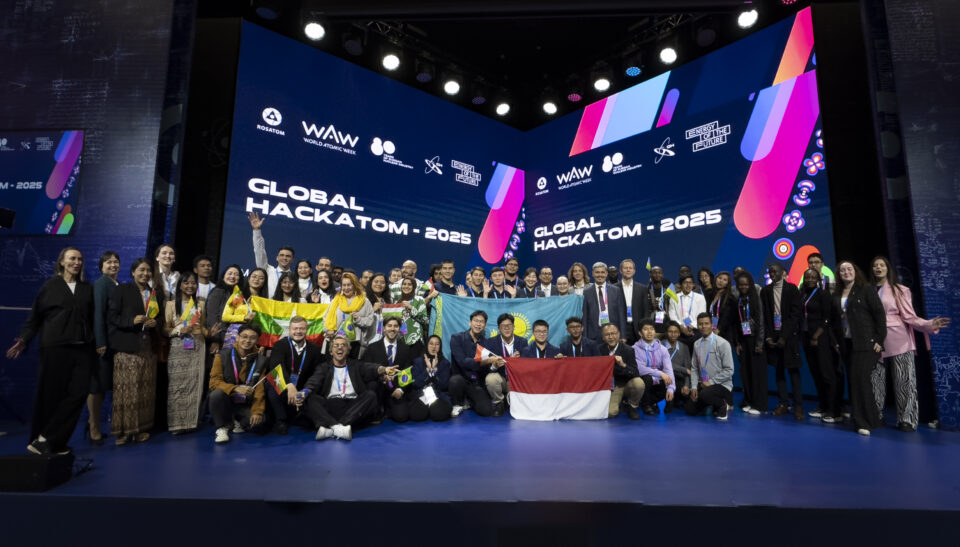
*Future innovators present visionary ideas linking clean energy and outer space
The first final of the Global HackAtom international student championship has been recently held with the support of Rosatom as part of the World Atomic Week youth programme in Moscow. Over 50 winners of national rounds from Russia and nine other countries took part in the event, united by one theme — space exploration powered by nuclear technology.
Among the standout participants were talented students from Namibia and Rwanda — representing the growing scientific potential of the African continent. Their performance in the national rounds, held at the University of Namibia in Windhoek and the University of Rwanda in Kigali, showcased how Africa’s young minds are embracing nuclear science as a pathway to innovation, clean energy, and sustainable development. As part of the global finalist pool, they symbolise the continent’s bright and determined future in tech fields.
“Today, you took a look into the future and presented projects that could make a breakthrough in human space exploration through the use of nuclear technology. You are already the best! You are the shining example and future engineering and technological elite of your countries!” noted Rosatom Deputy Director General for Human Resources Tatyana Terentyeva.
The TUPI Tech team from Brazil emerged as the winners of the competition, presenting a modular nuclear reactor design to support space exploration and provide resources for interplanetary missions. The Tahu Sumedang team from Indonesia came in second with their concept of applying nuclear technologies to maintain circadian rhythms on deep space missions. The IsotopeX team from Hungary placed third with their project for a nuclear power source for a device to monitor fluid retention and vital signs of space travelers while they are asleep.
“The Global HackAtom international championship has emerged as a unique platform. The national rounds of the championship took place in ten countries, bringing together over 160 teams and 650 participants with various cultural background from various nations. These events help broaden perspectives and create a space for the birth of bold and innovative ideas. We see that nuclear science and technology are becoming essential for future space exploration, including reliable energy sources on the Moon and Mars, as well as faster interplanetary travel. These events provide a platform for organising teams that are to achieve these goals in the nearest future,” highlighted RAIN Private Institution CEO Vadim Titov.
The jury included representatives from Rosatom, Russian Society Znaniye (“Knowledge”), popularisers of astronomy, and representatives from field-specific engineering universities. The culmination of the championship was the presentation and defense of projects by participants on September 28. The contestants presented their solutions for interplanetary travel, the construction of the first space NPP, and the creation of a “Silk Road 2100” in outer space. Experts praised the teams for the high level of their preparation and visionary ideas.
Beyond the competition itself, Global HackAtom demonstrated how nuclear science can inspire the next generation of innovators. The event became a networking hub where students and experts discussed the role of nuclear energy in advancing clean technologies, space research, and sustainable growth across developing regions.
Global HackAtom is an international student championship that offers participants the opportunity to find a solution to real-life nuclear industry cases within a 24-hour timeframe. This year’s event features a new format, consisting of two stages: the national selection rounds and the grand final in Russia. The national rounds were held in 10 countries, including Bolivia, Brazil, Hungary, Indonesia, Kazakhstan, Myanmar, Namibia, Russia, Rwanda, and Uzbekistan. Over 650 students from these countries participated in the competitions, forming a total of over 160 teams. After the national rounds, 10 teams were selected as finalist teams of the most promising students who demonstrated their research potential and enthusiasm for nuclear science and technology.