
By Charles Okonji
In a paradigm shift, Nigeria’s leading maritime, aquaculture, and governance voices converged in Lagos for the 2025 Gender & Blue Economy Conference with a unified message that the country cannot achieve sustainable blue-economy growth without embedding gender equality at the centre of education, research, and national development planning.
At the conference organised by the Centre for Gender Economics (CGE Africa) and the National Working Group on Gender and Blue Economy, stakeholders from government, academia, industry, and coastal communities underscored the urgent need to unlock the country’s marine and aquatic potential by ensuring women and girls become full, active participants in the sector.
Delivering a goodwill message on behalf of the Nigerian Maritime Administration and Safety Agency (NIMASA), Mrs N. Y Okeke who represented the Director-General Dr. Dayo Mobereola, praised CGE Africa for sustaining a platform that champions gender inclusion in Africa’s emerging blue economy.
She reiterated that Nigeria’s maritime growth cannot be achieved without the meaningful participation of women and other marginalised groups at all levels of the sector.
Okeke reaffirmed NIMASA’s commitment to gender-responsive policies, capacity-building, and expanded leadership opportunities for women, noting that a safer, more inclusive maritime environment is essential for national prosperity.
She described the conference as “timely,” adding that its outcomes would shape a more equitable and productive blue economy for Nigeria.
Representing the international scientific community, Dr. Foluke Areola, President of the World Aquaculture Society (WAS) African Chapter and President-Elect of the global body, emphasised that education, research, and innovation must guide Nigeria’s quest for a gender-inclusive blue economy.
She commended CGE Africa for its research-driven advocacy and for providing evidence-based solutions to gendered economic inequalities.
Areola noted that the goals of WAS including sustainability, environmental stewardship, and empowerment of women, youth, and marginalised coastal communities align with Nigeria’s national priorities.
She called for expanded training, technology transfer, and community-based research that enhances climate resilience, boosts productivity, and ensures equitable access to economic opportunities in fisheries and aquaculture.
In her keynote address, Secretary to the Lagos State Government, Barr. Bimbola Salu-Hundeyin, highlighted the critical role Lagos plays as Nigeria’s coastal powerhouse.
Speaking on behalf of the state government, she stressed that the blue economy spanning transport, food systems, marine tourism, and shoreline management, offers some of Nigeria’s most promising pathways for economic growth, noting that provided gender inclusion is intentionally prioritised.
Salu-Hundeyin celebrated Lagos State’s achievements, including reforms in water transport through LASWA and LAGFERRY, investments in research and technology at Lagos State University, and the integration of women into leadership, environmental governance, and entrepreneurship.
She pointed out that women represent less than 20 percent of the global blue-economy workforce, describing the imbalance as “a social concern and an economic loss.”
To close this gap, she urged public and private institutions to expand access to scholarships, mentorships, maritime studies, and STEM programmes for girls. “When women are excluded, we lose ideas, innovation, and capacity,” she said, warning that the blue economy cannot thrive if half of Nigeria’s population is left behind.
Setting the tone for the day’s conversation themed “Building a Gender-Inclusive Blue Economy through Education and Research for Sustainable Growth in Nigeria”, Ms. Uchenna Idoko, host of the conference and Head of the National Working Group on Gender & Blue Economy, delivered a compelling welcome address that underscored why gender equality must be central to Nigeria’s maritime strategy.
Idoko said the theme of the conference was deliberately chosen to spotlight the engines of transformation required to shift the industry. “Education gives us the human capital. Research gives us the evidence. Leadership gives us the courage to act. Together, they give us the future,” she said.
She highlighted the vast opportunities in fisheries, transport, ocean innovation, and coastal tourism, while noting that women remain underrepresented despite being indispensable contributors to coastal resilience and marine livelihoods.
Idoko encouraged participants to imagine new possibilities for girls and women in ocean-related careers, reminding attendees that the blue economy is not just a sector but “a promise to protect our waters, empower our girls, elevate our women, and create a Nigeria where every child who grows up by the ocean sees possibility.”
As Nigeria expands its marine and blue-economy agenda, this year’s conference reaffirmed a clear national consensus: sustainable development will only be achievable when women and girls have equal access to the knowledge, leadership pathways, and research-driven opportunities that define the future of the country’s waters.
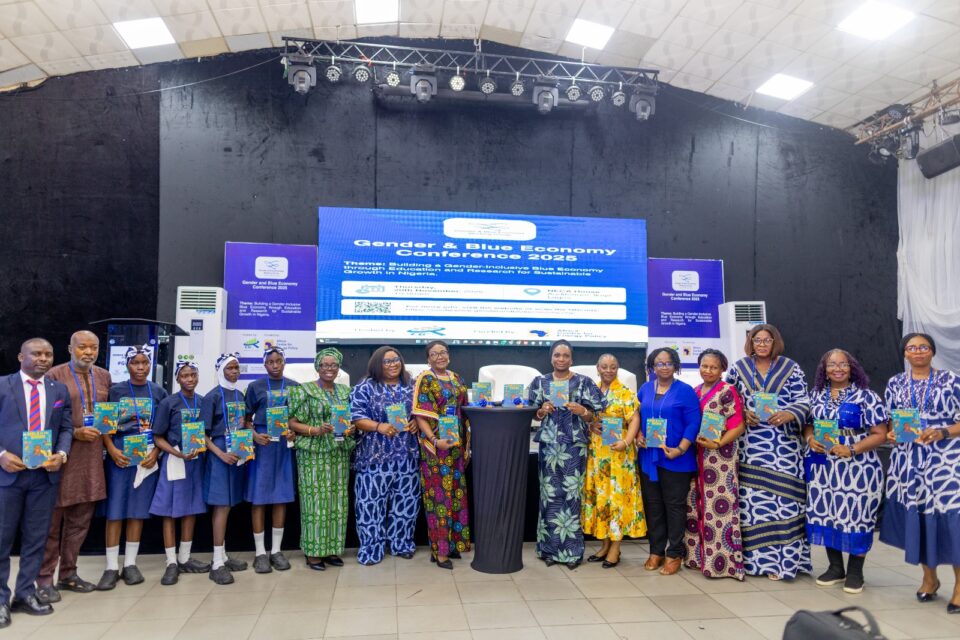
The highlight of the conference was the unveiling of a book titled “Girls By The Shore: A Girl’s Guide To The Blue Economy” written by Ms Uchenna Idoko.