
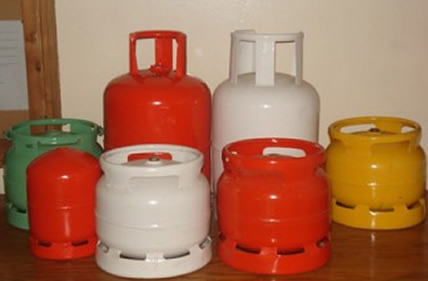
Photo caption: Cooking gas cylinders
Liquefied Petroleum Gas (cooking gas) retailers have raised the alarm over persistent supply shortages, saying fresh LPG shipments into the country have done little to improve availability as prices soar and consumers groan under rising energy costs.
The retailers said cooking gas supply remained severely constrained, warning that scarcity and high prices may persist if the government fails to address the situation.
The development comes amid growing complaints from consumers across the country over the rising cost of cooking gas, with neighbourhood retailers in some locations selling the product for as much as N2,400 per kilogramme.
In an interview with The PUNCH, the Chairman of the Liquefied Petroleum Gas Retailers Association of Nigeria, Ayobami Olarinoye, said that while supply improved slightly following the arrival of an LPG cargo in late May, marketers and retailers were still struggling to access products.
According to him, the current situation has made it extremely difficult for retailers to obtain gas from plant operators, thereby worsening supply challenges in the downstream market.
“The cooking gas situation remains almost the same. Though the supply was a little bit better because a shipment of LPG came in late May (owned by a company I will not like to mention), the price remains high,” Olarinoye said.
He added that another LPG vessel arrived in the country on June 3 but alleged that the product was being reserved for the owner’s retail outlets.
“I got information that another ship belonging to another company arrived on June 3. The company has multiple gas stations. According to my source, the company is saying the shipment is only for their stations and not to be sold to any marketers. If marketers (plant owners/operators) don’t have gas, there is no way LPGAR members (retailers) can get the product to sell,” he said.
Describing the situation facing retailers, Olarinoye said access to products had become increasingly difficult in recent weeks.
“Getting the product has been excruciatingly difficult and it is not readily available. Out of every 10 plants, only one or two would have products to sell to our members. Many of them, especially those situated in relatively residential areas, prefer to sell directly to end-users, while a few are still selling to retailers,” he stated.
He warned that prices were unlikely to decline in the immediate term unless there was an intervention. “The high price may remain the way it is until the situation changes positively,” the LPGAR boss noted.
Olarinoye also linked part of the supply challenge to the export of locally produced LPG, saying a local refinery sells to the Benin Republic to earn foreign currency.
“We understand a private local refinery is selling most of its product to West African customers in foreign currency, which is more profitable for the company than selling in the local currency,” he added.
He called on the Federal Government to create incentives that would encourage more investors to enter the LPG market and boost local supply.
“Our appeal is to the Federal Government to further encourage investors by giving incentives to other promising refineries to fast-track the process so we can have multiple players in the system. Also, the government should ensure that terminal owners do not abuse the system by hoarding the product,” he pleaded.
The PUNCH reports that retailers in several neighbourhood shops have run out of supply, with the few that have the product selling at exorbitant prices.
A retailer identified simply as Temmy in the Sagamu area of Ogun State told our correspondent that she had been out of stock since last Monday, and efforts to restock had been futile. “All my suppliers said they don’t have stock. Since last week, my cylinders have been empty. We don’t know what’s happening,” she said on Sunday.
The concerns raised by retailers come as consumers across major cities lament the continued increase in cooking gas prices. Nigerians have expressed concern over the rising cost of LPG, with prices surging to as high as N2,400 per kilogramme in some retail outlets, depending on location.
While consumers have endured a steady rise in prices over the past year, many said the latest scarcity of the product has become unbearable.
A survey by The PUNCH showed that some filling stations sold the product at relatively lower prices ranging between N1,650 and N1,700 per kg, while neighbourhood retailers charged significantly higher rates.
A Lagos resident, Desire Billy, said many households were increasingly turning to alternative cooking methods because of the rising cost of LPG. “It has gotten to a point that you buy gas, and you are unable to use it in cooking beans,” she said, adding that coal pots are gradually returning to kitchens.
In Ilorin, Kwara State, some residents said they had abandoned cooking gas altogether. One resident, Kemisola Nitta, said, “The price has increased so much. In fact, some people have suspended selling. The price is too much. We have stopped using gas. We opted for charcoal. I think that is cheaper.”
Explaining the higher prices charged by retailers, a gas retailer in Ibadan, Opeyemi Olaire, cited transportation and operating costs. “I sell at N2,400 per kilogramme. If I buy from Gasland at N1,700 and use a bike to transport it at N600, how much do you want me to sell it for? The government should look for a way to bring the price down,” the retailer explained.
The persistent increase in LPG prices is occurring despite data from the Nigerian Midstream and Downstream Petroleum Regulatory Authority indicating that local production from refineries and gas processing plants accounted for the bulk of Nigeria’s LPG supply between April 2025 and April 2026, significantly reducing dependence on imports.
However, the increased domestic production has yet to translate into lower prices for consumers, with cooking gas now selling above N2,000 per kilogramme in several locations.
The Nigerian Association of Liquefied Petroleum Gas Marketers recently warned of looming scarcity and worsening hardship arising from erratic supply and rising costs.
The association said marketers were paying between N25.2m and N26.2m for 20 metric tonnes of LPG. “We feel that if the situation is not immediately checked, the citizens may rise against the owners of gas filling stations,” the marketers warned.
The association added that the situation had brought severe hardship to households, food vendors, small businesses and low-income earners who rely on LPG for daily cooking needs, warning that the crisis could reverse years of progress made in promoting clean cooking energy across the country.
=== PUNCH ===