
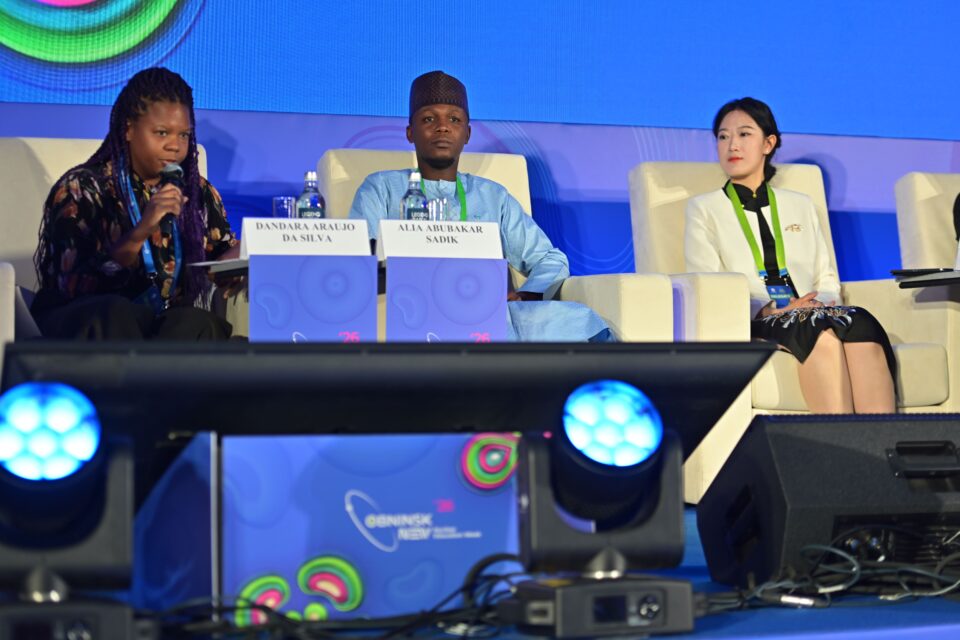
Photo caption: Alia Abubakar Sadik
Over 700 delegates from 85 countries, including Nigeria, gathered in Russia’s first science city
The fourth Obninsk NEW‑2026 International Youth Forum has concluded in Obninsk, Kaluga Region. The event focused on building a skilled workforce for the global nuclear power industry and was supported by Rosatom, the Government of the Kaluga Region, and the National Research Nuclear University MEPhI.
More than 700 participants from 85 countries took part in person, alongside high‑level delegations from 10 nations. Thousands more students joined online through 25 partner broadcasting platforms, making this year’s forum the largest to date.
The speaker line‑up underscored the forum’s growing international prestige. Attendees heard addresses from Director General of the IAEA Rafael Grossi, Director General of the World Nuclear Association Sama Bilbao y León, and Chairman of the Russian Government Mikhail Mishustin. A high‑level plenary session featured IAEA Deputy Director General Mikhail Chudakov, as well as heads of national nuclear agencies from partner countries, including Almasadam Satkaliev (Kazakhstan) and Azim Akhmedhadzhaev (Uzbekistan).
The programme was split into two parts. The morning sessions explored youth engagement: how young communities are reshaping the nuclear industry, what joint projects can emerge from international cooperation, and what role Obninsk could play in building a global network of young nuclear leaders. The afternoon was given over to expert panel discussions with representatives from various nuclear organisations.
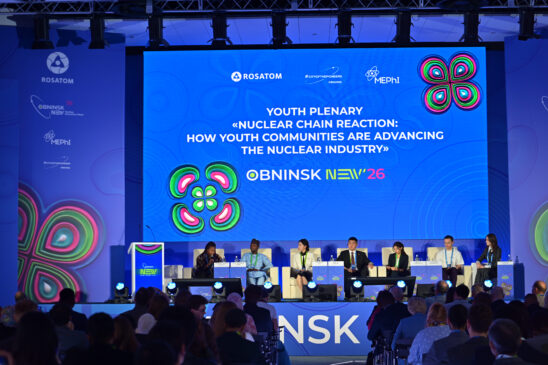
Photo caption: Nuclear chain reaction, how Youth Communities are advancing the nuclear industry
Special attention was given to the development of nuclear technologies in Africa. President of African Young Generation in Nuclear Alia Abubakar Sadik took part in the plenary session “Nuclear Chain Reaction: How Youth Communities Advancing the Nuclear Industry”. His participation confirmed the growing role of African youth in shaping the continent’s nuclear future – and underscored that building a sustainable nuclear sector requires more than just importing technology.
“African countries need to develop knowledge based on their own backgrounds and foundations. Importing a technology is one thing, but understanding it for future operations and maintenance is another,” noted Alia Abubakar Sadik.
A separate highlight was the meeting between Rosatom Director General Alexey Likhachev and the new members of the Impact Team 2050 International Youth Council – 13 young leaders from 13 countries. They discussed ways to promote the message of peaceful nuclear energy among younger generations and to contribute to the UN Sustainable Development Goals.
“Our mission is to meet the global challenge of training qualified specialists for the nuclear industry. The world’s growing reliance on nuclear power requires not only new technologies, but also a robust international education system. In Obninsk – Russia’s first science city – we are building exactly that kind of open, modern, forward‑looking environment. The Obninsk Tech international education cluster is already taking shape here with IAEA support, and the agreements signed today will help us scale up Russian nuclear engineering education abroad,” highlighted Alexey Likhachev.
Tangible outcomes included two agreements signed in the presence of Rosatom, Minister of Science and Higher Education Valery Falkov, and Kaluga Region Governor Vladislav Shapsha. The documents are designed to promote Russian engineering education in nuclear technologies abroad and to give further momentum to the Obninsk Tech project, which is being developed with IAEA support.
Russia continues to expand cooperation with all interested countries, and major international projects are moving forward with Rosatom and its divisions playing an active role. For Nigeria, the forum was more than a dialogue platform. As Africa’s most populous nation, Nigeria views nuclear power as a strategic part of its energy future, and Rosatom has been a long-standing partner in training and infrastructure development. Nigeria’s participation in the Obninsk NEW’26 confirms the country’s serious commitment to becoming a full-fledged member of the global nuclear community – and to ensuring that its people not only use nuclear technology, but truly understand and own it.
According to IAEA projections, global nuclear capacity could triple by 2050. That means countries will need not just reactors and infrastructure, but also tens of thousands of well‑trained specialists ready to operate in a new energy landscape. Obninsk Tech – the International Scientific and Education Centre for Nuclear and Related Education – was created precisely to address this need. By 2030, the centre aims to capture up to 20% of the global market in this field and train at least 10,000 specialists, at least half of them foreign students. In its first four years, it has already trained over 5,000 people from 100 countries. Eight new laboratory complexes have been completed at MEPhI (the cluster’s base university), and students from 16 countries are already gaining hands‑on experience there.
The Obninsk NEW International Youth Nuclear Forum is the leading global discussion platform for key technologies, innovation and education in the nuclear industry, with a special focus on future energy systems and new materials.