
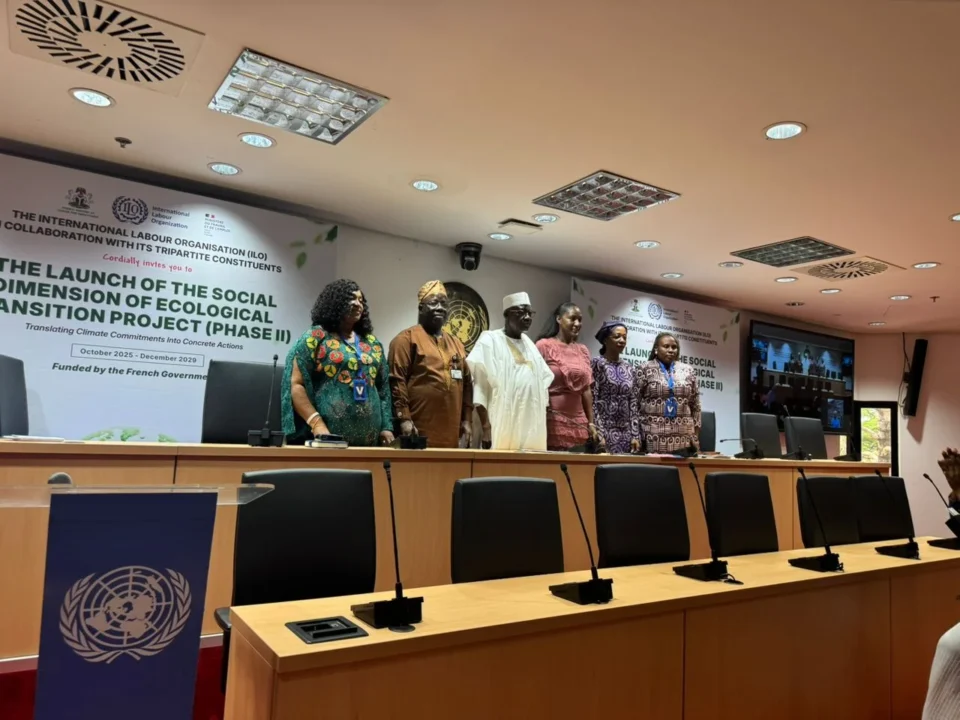
Photo caption: Minister of Labour and Employment, Dr. Muhammad Dingyadi, ILO Country Director for Nigeria, Ghana, Liberia, Sierra Leone and the ECOWAS Liaison Office, Dr Vanessa Phala, Permanent Secretary of the Ministry of Labour and Employment, Dr. Kamil Shoretire, Dr Kamil Shoretire, Director-General of the National Council on Climate Change, Mrs. Tenioye Majekodunmi at the International Labour Organisation and Tripartite Constituent Social Dimension of Ecological Transition (phase II) project launch in Abuja on Thursday. Photo credit: Deborah Musa
The Federal Government has launched Phase II of the International Labour Organisation Social Dimension of Ecological Transition Project, reaffirming its commitment to ensuring that Nigeria’s transition to a low-carbon economy creates decent jobs, protects workers and promotes inclusive economic growth.
The project, funded by the French Government through the ILO’s technical cooperation programme, was launched on Thursday at the UN House in Abuja, bringing together government officials, employers, workers’ organisations, development partners and climate experts to strengthen Nigeria’s just transition agenda from 2025 to 2029.
Speaking at the launch, the Minister of Labour and Employment, Dr Muhammad Dingyadi, said the renewed partnership presents an opportunity to move beyond policy commitments to practical implementation.
“It is my honour to deliver this keynote address at the launch of Phase II of the International Labour Organisation project on the Social Dimension of Ecological Transition.
“This gathering comes at an important moment as Nigeria deepens its commitment to climate action in a manner that advances decent work, social justice, sustainable enterprise development and inclusive growth,” he said.
According to the minister, Phase II will build on the successes of the first phase by supporting sustainable businesses, creating green jobs and strengthening community resilience.
“The renewal of this programme from 2025 to 2029 is an opportunity to move from policy commitment to implementation and to turn shared aspiration into measurable progress for workers, employers and communities,” he said.
Dingyadi noted that the first phase strengthened national capacity through evidence generation, social dialogue and policy engagement, leading to the development of Nigeria’s Just Transition Guidelines and Action Plan.
He stressed that implementation would determine the project’s success.
Calling for collaboration among stakeholders, the minister said: “I therefore call on every institution represented here to move from commitment to coordinated action. Let us align our resources, expertise and social justice platforms behind the implementation of Phase II.
“The real test is implementation. Commitments must become investments, policies must become programmes and programmes must produce results that citizens can see and feel.
“As we launch Phase II of the Social Dimension of Ecological Transition project, let us proceed with confidence, cooperation and patriotism. Let us work together to ensure that Nigeria’s climate commitments deliver decent jobs, stronger enterprises, resilient communities, social justice and renewed hope for all Nigerians.”
Earlier, the ILO Country Director for Nigeria, Ghana, Liberia, Sierra Leone and the ECOWAS Liaison Office said the project has evolved into a major platform for promoting a just transition in Nigeria.
“As you know, this is a collaboration between the International Labour Organisation and the French government through our technical cooperation,” the country director said.
Highlighting achievements recorded during the first phase, the ILO official said, “In the first phase, we’ve done a lot, especially around the area of capacity building. We’ve engaged hundreds of different government institutions and social partners, where we’ve trained and provided capacity on the just transition.”
The country director described Nigeria’s integration of just transition into its NDC 3.0 as a landmark achievement.
“Most importantly, we also integrated just transition in the recent year of the International Inter-Bank Contribution, NGC 3.0. And for us at the ILO and the country as Nigeria, it was a big tick, because this was the first time when we actually integrated just transition into the NDC and also, Nigeria took a very firm leadership in this, because it’s one of the few countries that have done so.”
She said the second phase would focus on promoting durable clean energy solutions and supporting the gradual transition from conventional energy sources to sustainable alternatives.
The ILO also reaffirmed its commitment to supporting Nigeria’s climate and labour priorities.
“You can always count on the International Labour Organisation to do our bit in supporting the implementation of the renewable agenda and the implementation and attainment of the various policy objectives and policy priorities of the governments of Nigeria.”
In his opening remarks, the Permanent Secretary of the Ministry of Labour and Employment, Dr Kamil Shoretire said lessons from Phase I would guide implementation of the new phase.
“We’ve learned, amongst others, that data must be well-generated and evidence for planning for a just transition,” he said.
Expressing optimism that stronger collaboration and additional funding would help deliver greener jobs and sustainable energy solutions.
Also speaking, the Director-General of the National Council on Climate Change, Mrs Tenioye Majekodunmi, said climate action must remain people-centred and inclusive.
“We are living in an era where climate action can no longer be coupled with human dignity, human justice and economic survival,” she said.
She noted that the council would use the second phase to align implementation of Nigeria’s Just Transition Guidelines and NDC 3.0 with practical interventions, including clean energy and clean cooking initiatives capable of creating jobs and reducing poverty.
Majekodunmi urged stakeholders to work together to ensure that Nigeria’s ecological transition remains fair and sustainable.
“We want the social and economic outcomes of this project to be directly contributed by NCC to preserve our solution. Because this would prove that emission reduction has no hand in transit, job creation and poverty reduction.
“Together, let us build an ecological transition that is green in its constitution, equitable in its nature and sustainable for generations to come.”