
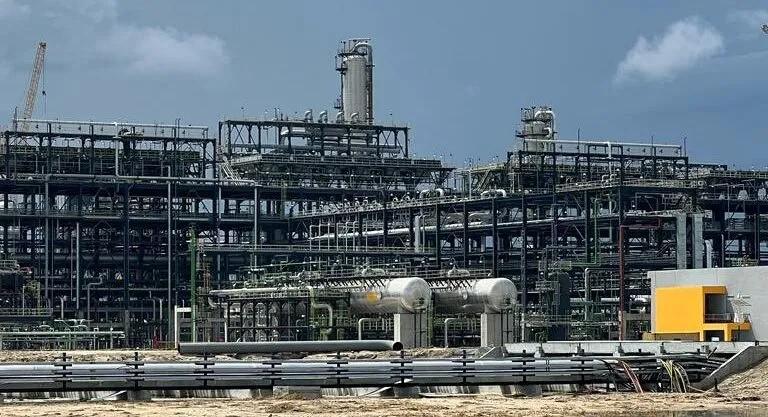
Photo caption: Dangote Refinery

Photo caption: SEE logo
*Cites current feedstock supply challenges faced by the refinery and other local refineries in Nigeria
By Emeka Ugwuanyi
The Society of Energy Editors (SEE) has noted with keen interest the audacious announcement by the Dangote Group to more than double the capacity of its landmark refinery to 1.4 million barrels per day (bpd) by 2028. This bold vision, if realized, will not only cement the facility’s status as the largest single-site refinery in the world but represents a monumental leap for Nigeria’s long-held dream of energy self-sufficiency and export dominance.
In a statement by Society entitled “A Reaction from the Society of Energy Editors (SEE). Dangote’s Ambition and NNPC’s Paralysis: A Tale of Two Refineries and Nigeria’s Energy Future,” the Group said: “We hail the immense patriotism and investment drive demonstrated by Aliko Dangote and his Group. In a climate often characterized by investor trepidation, this commitment of billions of dollars is a powerful vote of confidence in the Nigerian economy and its industrial potential. The operationalization of the first phase has already begun to alter the dynamics of the downstream sector, and this planned expansion signals an ambition that aligns with the nation’s economic aspirations.”
Interrogating the Feedstock Conundrum: Ambition Must Meet Reality
However, ambition must be grounded in pragmatism. The SEE is compelled to interrogate the single most critical question that this expansion plan raises: the sourcing of crude oil feedstock.
It is a matter of public record that even at its current capacity of 650,000 bpd, the Dangote Refinery has had to resort to importing crude oil from other countries, including the United States, to make up for domestic supply shortfalls. This paradox—a Nigerian refinery importing crude—is a stark indictment of our upstream oil and gas sector’s inability to meet local demand. If this is the challenge at 650,000 bpd, the question becomes existential at 1.4 million bpd.
Therefore, we pose the following critical questions to the Dangote Group:
- What specific, long-term crude supply strategy is in place to feed this colossal expansion? Are we to expect a permanent reliance on imported crude, which exposes the refinery to foreign exchange volatility and geopolitical risks?
- What partnerships or upstream acquisitions are being pursued to secure equity production and insulate the refinery from the vagaries of the domestic crude allocation system?
- Has the Group engaged in high-level, binding agreements with the Nigerian National Petroleum Company Limited (NNPCL) and international oil companies to guarantee a dedicated stream of Nigerian crude?
Without clear and concrete answers to these questions, this grand expansion risks being a magnificent asset operating far below its potential, its economic promise hamstrung by the very same resource curse that has plagued the nation for decades.
The NNPC Ltd. Conundrum: A History of Failed Promises and Wasted Billions
This discourse inevitably leads us to the elephant in the room: the moribund state of the nation’s federally-owned refineries in Port Harcourt, Warri, and Kaduna. For years, these assets have lain in ruins, symbolizing national inefficiency and a staggering drain on public funds. The NNPCL management, and by extension the Federal Government, must now provide a credible and transparent roadmap.
The narrative of “rehabilitation” is one Nigerians have heard for over a decade, with nothing to show for it but billions of dollars flushed down the drain in phantom turnaround maintenance contracts. Therefore, we must interrogate the current management:
- Beyond press releases, what are the concrete, verifiable milestones and timelines for the Port Harcourt Refinery and others? The Nigerian public deserves real-time, unbiased updates on the progress, not just promises.
- Given the colossal failure of previous rehabilitation attempts, what is different this time? What new contracting, oversight, and technical models are in place to ensure that this attempt does not become another expensive national embarrassment?
- What is the long-term vision for these assets? Is the plan to eventually compete with Dangote, to complement it by focusing on specific products, or to be integrated into a larger energy hub? The current ambiguity is unacceptable.
Conclusion
The Dangote Refinery’s expansion is a private-sector moon-shot that deserves cautious applause. The state of the NNPCL refineries is a national tragedy that demands urgent, transparent action.
For Nigeria to truly achieve energy self-sufficiency and become a net exporter, both narratives must converge towards success. The Dangote Group must solve its feedstock puzzle, and the NNPCL must, for once, deliver on its promises. The SEE will continue to monitor these developments closely, holding both private and public actors accountable, for the energy security of Nigeria is far too important to be left to chance or empty rhetoric.