
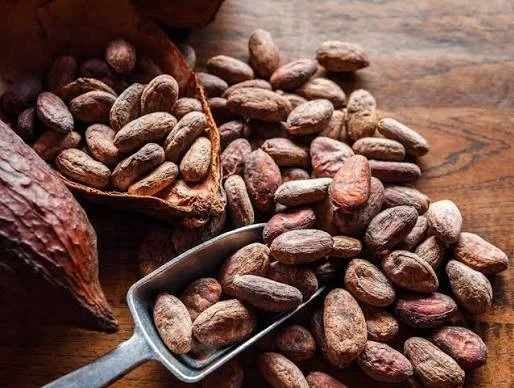
Photo caption: Cocoa seeds. Photo credit: Kron
The Federal Government will next Tuesday host Cameroon, Côte d’Ivoire and Ghana in Abuja for a landmark summit where the four countries will launch a historic alliance to end decades of exporting raw cocoa beans and begin negotiating with global markets as a united bloc.
The four countries, which together account for about two-thirds of global cocoa production, are expected to sign the Abuja Declaration at the Cocoa Value Addition Summit 2026 in Abuja, establishing a Cocoa Value Addition Alliance to coordinate policies, promote local processing, harmonise standards and strengthen Africa’s bargaining power in the global cocoa industry.
Nigeria will also sign a separate Cocoa Value Addition Accord, a national compact that will bring together the federal government, governors of cocoa-producing states, farmer organisations, industry groups, researchers and development finance institutions to deliver measurable improvements in cocoa processing, farmer incomes and investment.
The development was disclosed in a statement issued on Friday by the Special Assistant, Media Office of the Minister of State for Industry, Odenke Ibiang in Abuja.
According to the statement, the summit, themed “From Bean to Brand,” represents a turning point for Africa’s cocoa industry as producing countries seek to retain more value from the commodity instead of exporting raw beans for processing abroad.
The statement read, “The countries that grow most of the world’s cocoa will gather in Abuja on Tuesday to declare that the century of exporting raw beans is over.
“At the Cocoa Value Addition Summit 2026, convened by the Federal Government of Nigeria under the theme From Bean to Brand, delegations of Cameroon, Côte d’Ivoire, Ghana and Nigeria will sign the Abuja Declaration, establishing a Cocoa Value Addition Alliance through which the four nations, the source of some two thirds of global cocoa production, will negotiate, set standards and engage world markets as one bloc.”
Speaking ahead of the summit, the Minister of State for Industry, Senator John Owan Enoh, said African cocoa-producing countries were determined to change a century-old trade model that has left producing nations with little economic value despite supplying most of the world’s cocoa.
“For a hundred years, Africa has sent its cocoa to the world in sacks and received it back in wrappers, paying at both ends of the transaction,” said Senator John Owan Enoh, Honourable Minister of State for Industry, who will host the Summit.
“The distance between a bean and a brand is measured in jobs and in dignity, and on Tuesday, in Abuja, four nations begin closing that distance together. We do not gather to lament the market. We gather to redesign our place in it,” he added.
The minister, who is also a cocoa farmer from Cross River State, is expected to deliver the keynote address during the summit.
According to the organisers, the newly proposed alliance will enable the four countries to negotiate collectively with international buyers, coordinate industry standards and adopt common positions on issues affecting the global cocoa trade.
One of the immediate priorities of the alliance will be the implementation of the European Union Deforestation Regulation, which comes into effect for large and medium-sized operators on December 30, 2026.
Under the regulation, cocoa exported into the European Union must be fully traceable to individual farms, with proof that production did not contribute to deforestation.
The alliance is expected to adopt a unified position calling for recognition of national traceability systems while insisting that the cost of compliance should not be transferred to smallholder farmers.
The statement noted that the summit comes at a particularly volatile period for the global cocoa industry, with international prices fluctuating sharply over the past 18 months.
It observed that global cocoa prices surged to record highs above $11,000 per tonne before falling to about $3,000 per tonne and later recovering to around $5,000 per tonne, creating uncertainty for producers and exposing farmers to severe income fluctuations.
As part of Nigeria’s commitments, the Cocoa Value Addition Accord will establish measurable targets for expanding domestic cocoa processing, increasing farmers’ earnings, attracting new investments and strengthening the country’s cocoa value chain.
Implementation of the agreement will be supervised by a delivery council chaired by the Minister of State for Industry, while progress reports will be published annually to ensure transparency and accountability.
The summit will also feature goodwill messages from the Ghana Cocoa Board and Côte d’Ivoire’s Le Conseil du Café-Cacao.
A special financing session involving the Bank of Industry, the Nigeria Incentive-Based Risk Sharing System for Agricultural Lending and other development finance institutions is also expected to produce major financing announcements for the cocoa industry.
Participants will equally receive updates on the construction of what is expected to become Nigeria’s largest cocoa processing facility, a 70,000-metric-tonne processing plant being developed by Sunbeth Global Concepts in Sagamu, Ogun State, which is scheduled for commissioning in 2027.
The Cocoa Value Addition Summit 2026 is being organised by the Federal Ministry of Industry, Trade and Investment through the Office of the Minister of State for Industry, with the Bank of Industry serving as co-convener.
The statement added that the event forms part of the implementation of the Nigeria Industrial Policy under the Tinubu administration, which identifies agro-industrial value addition as a key strategy for economic diversification, industrialisation, export expansion and job creation.
Nigeria is the world’s fourth-largest cocoa producer after Côte d’Ivoire, Ghana and Indonesia, while Côte d’Ivoire and Ghana together account for more than half of global production.
Despite producing most of the world’s cocoa beans, African countries earn only a fraction of the value generated by the global chocolate industry because the bulk of processing, manufacturing and branding takes place in Europe and other developed economies.
The proposed Cocoa Value Addition Alliance is expected to reverse that trend by encouraging greater local processing, expanding manufacturing capacity, improving farmers’ incomes and increasing Africa’s share of the global cocoa value chain.