
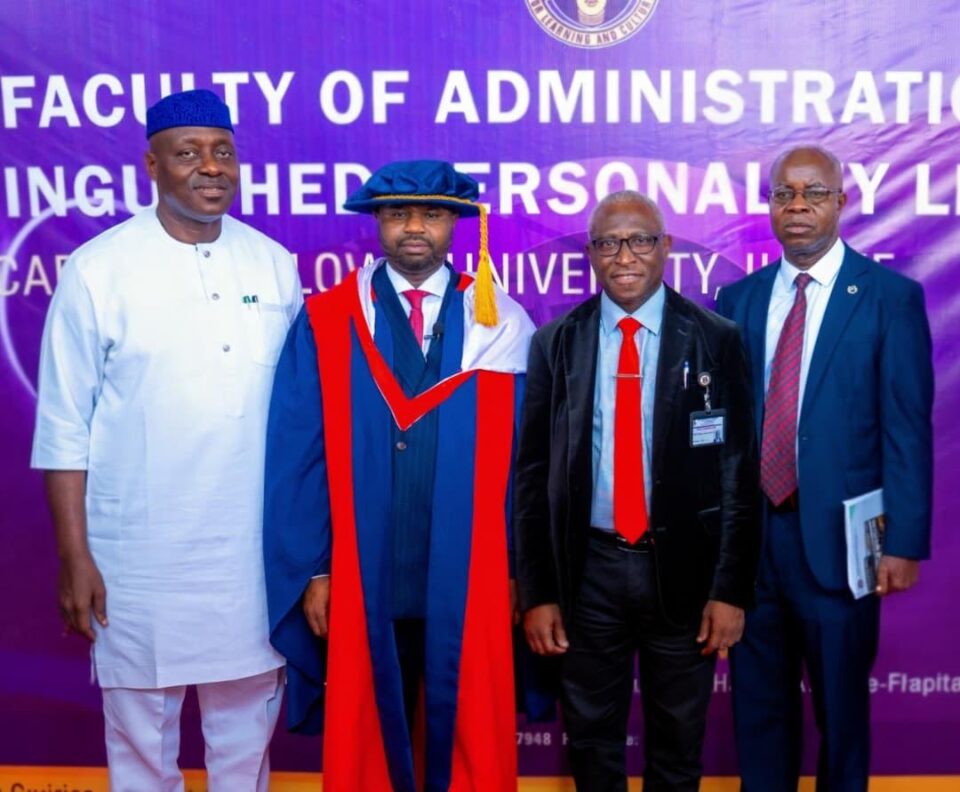
Photo caption: Photo caption from left: Vice-Chancellor, University of Ilesha, Professor Taiwo Ashaolu; chairman of the Nigeria Revenue Service (NRS) and distinguished personality lecturer, Dr Zacch Adedeji; the Vice-Chancellor, Obafemi Awolowo University, Ile Ife, Osun State, Professor Adebayo Bamire; Dean, Faculty of Administration of the university, Professor Rafiu Salawu, during the maiden edition of the distinguished personality lecture of the Faculty of Administration of the university delivered by Adedeji on Thursday.
*Diversified exports must be anchored on innovation, complex products
By Charles Okonji
In a wake-up call for economic prosperity through technical innovation and massive Diversification, the Chairman of the Nigeria Revenue Service (NRS), Dr Zacch Adedeji, has advised that Nigeria should migrate from dependence on raw material exports to one that embrace ideas, innovation and the production of complex products as a pathway to sustainable economic growth and national prosperity.
Adedeji made this call while delivering the maiden distinguished personality lecture of the Faculty of Administration, Obafemi Awolowo University (OAU), Ile-Ife, Osun State, on Thursday.
According to a statement by his Special Adviser on Media, Dare Adekanmbi, Adedeji, in the lecture entitled, ‘From Potential to Prosperity: Export-led Economy’, pointed out the need to rethink growth through the lens of complexity by not just producing more of the same stuff.
He decried that Nigeria possesses a high-tech oil sector and low-productivity informal sector as well as lacking “the vibrant, labour-absorbing industrial base that serves as a bridge to higher complexity.”
Adedeji noted that Nigeria witnessed stagnation in its exportation drive for three decades between 1998 to 2023, and only added six new products in its export basket list between 2008 and 2023.
“Because of our current position, the Harvard Atlas concluded that we are positioned to take advantage of very few opportunities to diversify using what we already know.”
He urged Nigeria to learn from the world by comparative study of success and failure like Vietnam, Bangladesh, Indonesia, South Africa and Brazil.
“We are not just looking at numbers in a vacuum; we are looking at the strategic choices made by nations like Vietnam, Indonesia, Bangladesh, Brazil, and South Africa over the same twenty-five-year period. While there are many ways to underperform, the path to success is remarkably consistent: it is defined by a clear strategy to build economic complexity.
“When we put these stories together, the divergence is clear. Vietnam used global trade to build a resilient, complex economy, while the others remained dependent on natural resources or a single low-tech niche.
“There are three big lessons here for us in Nigeria as we think about our roadmap. First, avoiding the resource curse is necessary, but it is not enough. You need a proactive strategy to build productive capabilities.
“Vietnam’s success came from integrating itself into Global Value Chains (GVCs). They positioned themselves as the assembly hub for the world’s electronics, importing high-tech parts and exporting finished products.
“This allowed them to “borrow” technology and management skills from abroad to build their own know-how.
“Nigeria, on the other hand, remains a supplier of raw materials to these chains, not an active participant within them. We must realise that productive capabilities are not permanent. The examples of South Africa and Brazil show us that you can actually lose your industrial edge if you are not careful. Over-reliance on the easy path of resource extraction creates economic and political incentives that crowd out the difficult, long-term work of building an industrial base.”
The NRS Boss said, for Nigeria which is at an even earlier stage of development and even less diversified than these nations, the warning is stark.
“Relying solely on our natural endowments isn’t just a path to stagnation; it’s a path to regression. The global economy increasingly rewards knowledge and complexity, not just what you can dig out of the ground. If we want to move from potential to prosperity, we must stop being just a source of raw materials and start being a source of ideas, innovation, and complex products,” Adedeji averred.
He stated that President Bola Tinubu has already begun the difficult work of rebuilding the economy to ensure collective knowledge to innovate, produce and build a resilient economy.
“The journey from potential to prosperity is not a short one, but with the right map and the right resolve, it is a journey we can finally complete,’ he stressed.