

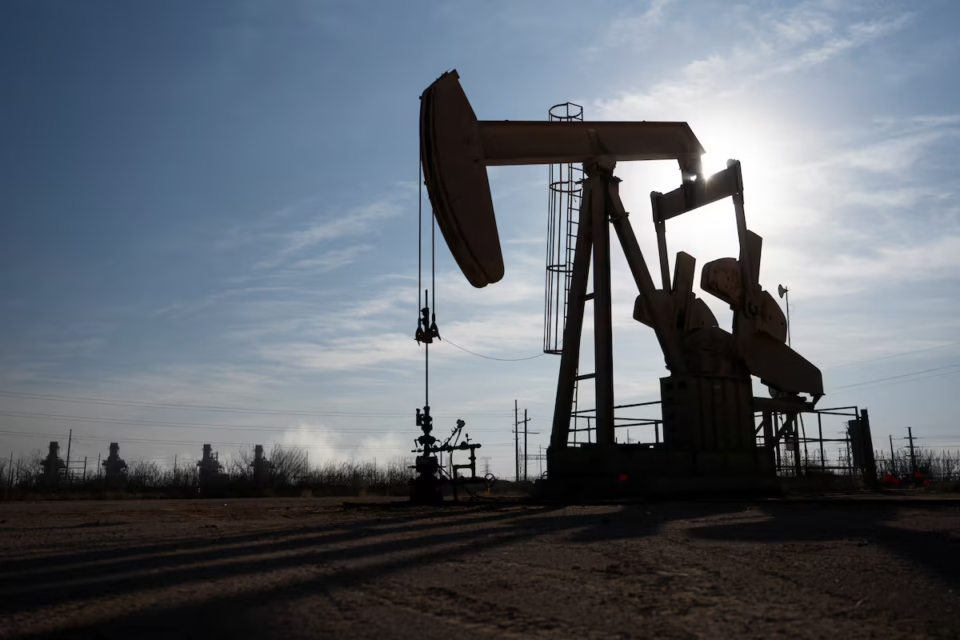
Photo caption: A pump jack operates near a gas turbine power plant in the Permian Basin oil field outside of Odessa, Texas, U.S. February 18, 2025. REUTERS/Eli Hartman Purchase Licensing Rights
*Benchmarks Brent and WTI extend gains
*US and Houthis attack ships in Gulf, Red Sea straits
*US crude inventories rise, refined fuels draw, industry data shows
Oil prices rose on Wednesday after attacks on two ships reinforced worries about disruptions to Middle East supplies, while industry data showing swelling inventories of U.S. crude might keep bulls in check.
Reuters reported that Brent futures were up 90 cents, or 1%, at $89.81 a barrel by 0757 GMT, set for their sixth day of gains. U.S. West Texas Intermediate (WTI) crude climbed 88 cents, or 1.1%, to $84.08, up for a fifth day. Both contracts earlier rose more than $1.
The United States and Yemen’s Iran-aligned Houthis reported separate attacks on shipping in the Strait of Hormuz and the Bab el-Mandeb Strait on Tuesday, two crucial export valves for Middle Eastern oil and gas in addition to the Suez canal.
Iran’s top security official said Hormuz would stay closed unless the U.S. accepted Iran’s conditions to end the war, including release of its frozen assets.
Shipping data showed the number of vessels transiting Hormuz fell to a one-week low of eight on Tuesday. Before the war, 125 to 140 vessels passed through the crucial waterway each day.
In Libya, the country’s National Oil Corporation said all fires at fuel storage tanks in the Zawiya oil complex were under control.
On the supply front, a Reuters poll showed that U.S. crude oil and fuel inventories were expected to have fallen last week.
However, market sources citing American Petroleum Institute data said U.S. crude inventories rose sharply, while gasoline and distillate stocks fell.
Crude stocks rose by about 9.1 million barrels, while gasoline and distillate inventories fell by 1.5 million barrels and 596,000 barrels, respectively, from the previous week, the sources said.
The crude build far exceeded expectations and, if confirmed by the Energy Information Administration report later on Wednesday, could ease market concerns about supply tightness, Haitong Futures said in a note.
Official numbers from the EIA, the statistical arm of the U.S. Department of Energy, are due at 10:30 a.m. ET (1430 GMT).
For longer-term supply, the EIA expected significant disruptions to Middle East crude supplies to persist through the end of 2027. The EIA said it expects 2026 Brent crude oil prices to average $86.81 a barrel, and WTI to average $80.88.