
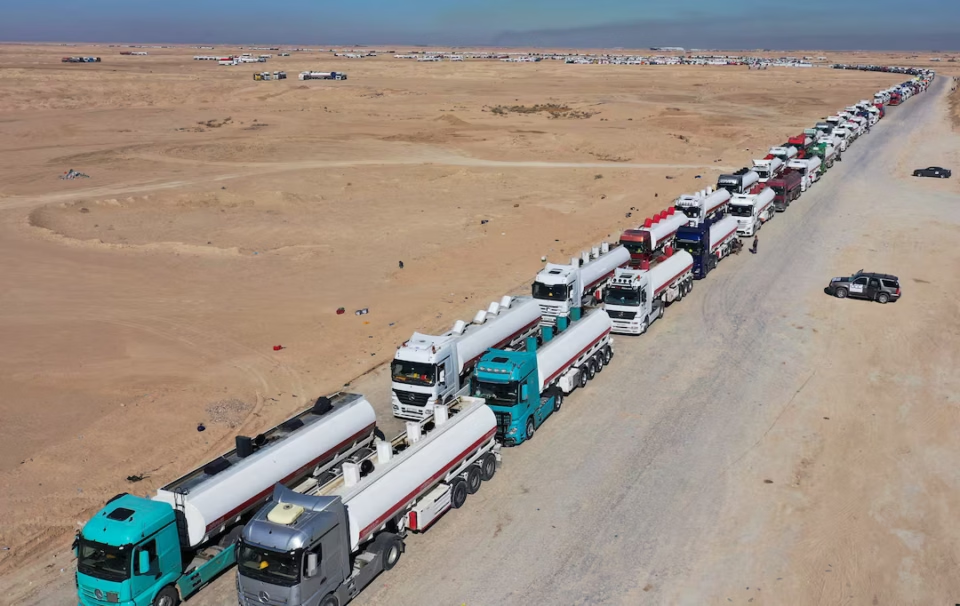
Photo caption: A drone view shows tanker trucks lined up outside the Tuba crude depot, where Iraqi crude is loaded onto tanker trucks for transport to Syria’s Baniyas Port, Basra, Iraq. REUTERS/Essam Al-Sudani Purchase Licensing Rights
*UCC loads120,000 to 150,000 barrels per day under SOMO contract, Basra Oil Company exec says
*Deal covers 5 million to 14 million barrels over three months from October 14, document shows
*Oil ships from Baniyas to Mediterranean refineries in Greece, Italy and Turkey, source says
Outside a depot near Basra, hundreds of tanker trucks queue to load Iraqi crude oil bound for the Syrian port of Baniyas via an overland desert route which had been largely unused for decades.
Iraq, OPEC’s second-largest producer, has been working to find alternative export routes for its oil since the Strait of Hormuz, its usual outlet, was disrupted by the Iran war.
Reuters reported that despite higher transportation costs, the overland route has also regained appeal because of an end to years of conflict in Syria, two people close to the matter told Reuters.
Although Iraq exports most of its crude from Gulf terminals, the Syrian route has become a small but strategically significant alternative for moving cargoes of heavy crude.
Since last month, Qatari energy group UCC Holding has been shipping Iraqi crude oil by truck to Baniyas, said Bassem Abdul Karim, director general of state-run Basra Oil Company (BOC).
UCC began shipping 120,000 to 150,000 barrels per day (bpd) under a contract with state oil marketer SOMO, with cargo volumes depending on truck availability, Abdul Karim added.
UCC and SOMO did not respond to requests for comment.
The crude is being trucked to the Mediterranean port of Baniyas from Iraq’s southern oilfields for export to international markets, Abdul Karim added.
UCC already has a fleet of 6,000 trucks which it is expanding to 10,000 for the route, and it currently has around 10,000 drivers, said a person familiar with the deal, adding that about 150,000 barrels are unloaded per day.
“We load crude oil at the Tuba storage facility and transport it to Baniyas, Syria. The round trip, including the return journey to Tuba, takes up to five days,” said Ishaq Mohammed, one of the tanker drivers.
Since the deal took effect on October 26, UCC has loaded about 1.6 million barrels, said Luay Jawad, manager of the Tuba storage facility near Iraq’s southern oil city of Basra.
UCC plans to load between 5 million and 14 million barrels of heavy crude over three months from October 14 at a discount of $38 per barrel, a document reviewed by Reuters showed.
Volumes are unlikely to rise above that level in the near future because of bottlenecks in truck supply and other constraints, the person familiar with the situation said.
The oil is loaded onto ships in Baniyas for delivery to Mediterranean refineries in Greece, Italy and Turkey, among others, the person added.
UCC is entitled to about $12 per barrel to cover trucking and related transportation costs through Syria under the deal.
Iraq produced nearly 4.5 million bpd in October, about half a million barrels more than a month earlier, according to secondary sources cited by OPEC in its latest monthly report.