
By Charles Okonji
The Nigerian Association of Chambers of Commerce, Industry, Mines and Agriculture (NACCIMA) has called on the Federal Government to ensure that Nigeria’s new tax regime and mandatory Environmental, Social and Governance (ESG) frameworks foster industrial growth rather than compound existing operational pressures on local manufacturers.
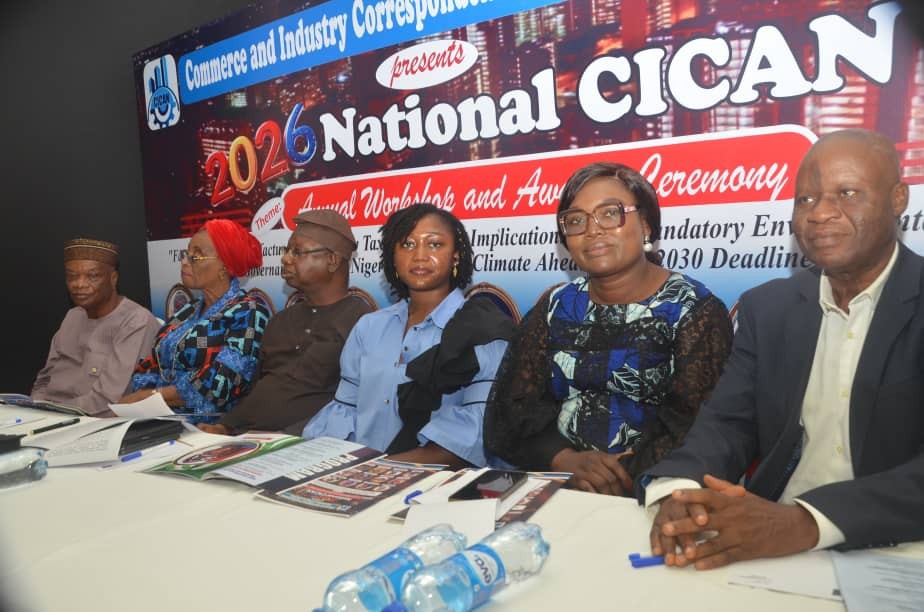
Speaking at the 2026 Annual Workshop and Awards Ceremony of the Commerce and Industry Correspondents Association of Nigeria (CICAN), NACCIMA DG, Dr. Olusola Obadimu emphasized that fiscal reforms must promote fairness, transparency, and predictability.
Obadimu noted that domestic producers are already contending with high energy costs, infrastructure deficits, expensive financing, and exchange-rate volatility.
Speaking on the focus on 2030 ESG compliance deadline, he acknowledged that sustainability standards can boost efficiency and unlock global export markets.
The NACCIMA DG reiterated that Micro, Small, and Medium Enterprises (MSMEs) require clear guidelines, technical assistance, affordable financing, and adequate transition periods to comply effectively.
Obadimu commended CICAN for bridging dialogue between policymakers and the private sector at the event, which was chaired by Alhaji Aliko Dangote alongside Princess ’Layo Bakare-Okeowo, and hosted by CICAN National Chairman Comrade Taiwo Hassan.
He reaffirmed NACCIMA’s commitment to advocating policies that strengthen manufacturing and economic diversification.
In her keynote, the Vice President of the Lagos Chamber of Commerce and Industry (LCCI), Princess Layo Bakare-Okeowo also warned the warned that implementing tax reforms that could stifle domestic production, asserting that Nigeria “cannot import its way to prosperity.”
Doubling as the Group Chairman of FAE limited, Bakare-Okeowo however commended efforts to harmonising taxation and streamlining administration.
She stressed that fiscal policy must drive industrial growth rather than focus solely on revenue collection.
”We must not tax the life out of the industries expected to drive our economic growth,” she stated.
She noted that while provisions such as expanded input Value Added Tax (VAT) recovery and capital expenditure tax credits are welcome incentives, their benefits risk being wiped out by severe operational headwinds, including high energy costs, foreign exchange volatility, steep interest rates, and infrastructure deficits.
She warned that layering new obligations like the 4 percent Development Levy and a 15 percent minimum effective tax rate onto struggling factories without fixing basic infrastructure could trigger factory closures, job losses, and a surge in import dependence.
To protect the sector ahead of 2027, the industrialist outlined a five-point agenda for the government, which are; “Targeted Tax Relief: Review cumulative tax burdens for strategic manufacturing investments. Affordable Energy: Provide sustainable solutions to lower industrial power costs. Accessible Incentives: Ensure capital investment tax credits are transparent and easy to claim. End Multiple Taxation: Harmonize revenue collection across federal, state, and local tiers, and Protect Local Production: Curb smuggling and dumping while boosting patronage of made-in-Nigeria goods.”
Echoing the same sentiment, the DG of Manufacturers Association of Nigeria (MAN), Mr. Segun Ajayi-Kadir, mni, emphasised that while the association supports modernizing tax administration, implementation must remain transparent, predictable, and respectful of established transitional provisions.
Ajayi-Kadir noted that MAN has kicked against any retrospective application of the 2025 Nigeria Tax Laws, warning that such moves create business uncertainty and undermine investor confidence.
According to him; “Our guiding principle is that the seed must be protected while the fruit is taxed. In practical terms, tax policy should preserve the capital and productive capacity that generate income and sustainable government revenue.”
The MAN boss also raised alarm over unresolved foreign exchange forward obligations, pointing out that the failure to honor valid contracts has dealt severe financial blows to manufacturers.
He urged authorities to urgently resolve the backlog to restore policy credibility and confidence in the sanctity of contracts.
Addressing the workshop’s theme on mandatory Environmental, Social, and Governance (ESG) standards ahead of the 2030 deadline, Ajayi-Kadir cautioned against adopting foreign sustainability frameworks wholesale.
He called for localised ESG guidelines backed by realistic transition timelines, affordable financing, and incentives, especially for small and medium-scale manufacturers, highlighting MAN’s Green Manufacturing Unit and energy efficiency initiatives as proof that sustainability and competitiveness can coexist.
Ahead of the approaching electoral cycle, Ajayi-Kadir challenged commerce and industry journalists to rigorously scrutinize the economic blueprints of political candidates, demanding measurable commitments to infrastructure, energy, and Made-in-Nigeria products.