

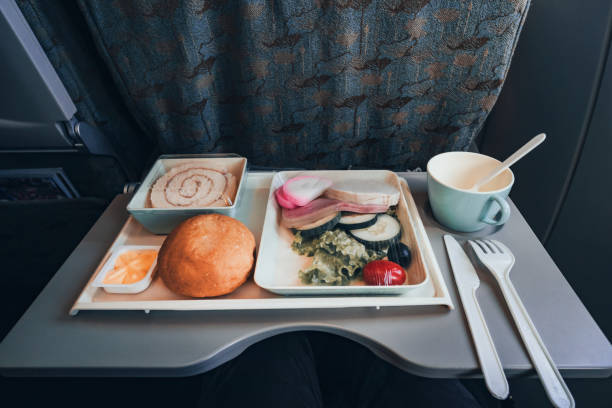
Photo caption: A web photo Airplane food.
A former flight attendant, Alex Quigley, has raised concerns about what passengers consume midair as Nigerians increasingly take to the skies, whether on early morning Lagos, Abuja shuttles or long-haul flights to London and Dubai.
Beyond choosing a window or aisle seat, what passengers eat and drink on board could impact their health far more than many realise.
Quigley, in an interview with Women’s Health on Friday, explained that one of the biggest red flags is the hot beverage service.
“Aeroplanes utilise potable water tanks, and often, that water sits there for a long, long time. There’s no telling how often or when the tank has been cleaned last,” he said.
Even more shocking, he revealed, “We were never allowed to pour the remaining coffee brewed into the drain of the airplane and were usually instructed to pour the coffee out into the toilet… I never knew or saw anyone empty and refill or wash them out in between trips.”
For many Nigerian travellers who rely on a quick caffeine boost during early morning flights, that revelation is unsettling.
It calls into question just how hygienic that free cup of coffee or tea really is.
Quigley also cautioned against strong-smelling snacks, noting that what may be appetising on the ground can quickly become overwhelming in a pressurised cabin.
He admitted, “We actually serve (corn nuts) in our first-class snack basket. The roasted barbecue flavour is the worst. When you open the bag, it smells like something is burning on the plane.”
Similarly, meat-based meals served during flights may not always be the safest choice.
Quigley warned that delays and long ground times can compromise storage conditions.
“You’re putting the trust of storing any meat in the flight attendant’s hands… food poisoning on a plane? No thanks!” he added.
Even what you eat before boarding matters.
Gas-inducing foods, like beans, fatty meals, dairy or sodas, can leave you feeling uncomfortably bloated once in the air.
“Air in the aeroplane is circulated, but it’s never fresh. That means if someone passes gas, you’re breathing that in over and over again,” Quigley noted.
And while many passengers enjoy a glass of wine or cocktail to settle in, alcohol can hit harder at high altitude.
Quigley explained, “You’re not actually doing yourself a favour by drinking on a flight. When pressure is decreased in the aeroplane, the body can’t absorb oxygen as well,” leaving travellers more dehydrated and light-headed.
Another flight attendant added that Bloody Marys and orange juice-based drinks are particularly harsh, as they are often salty or highly acidic.
“I always tell folks to drink water,” she said.