
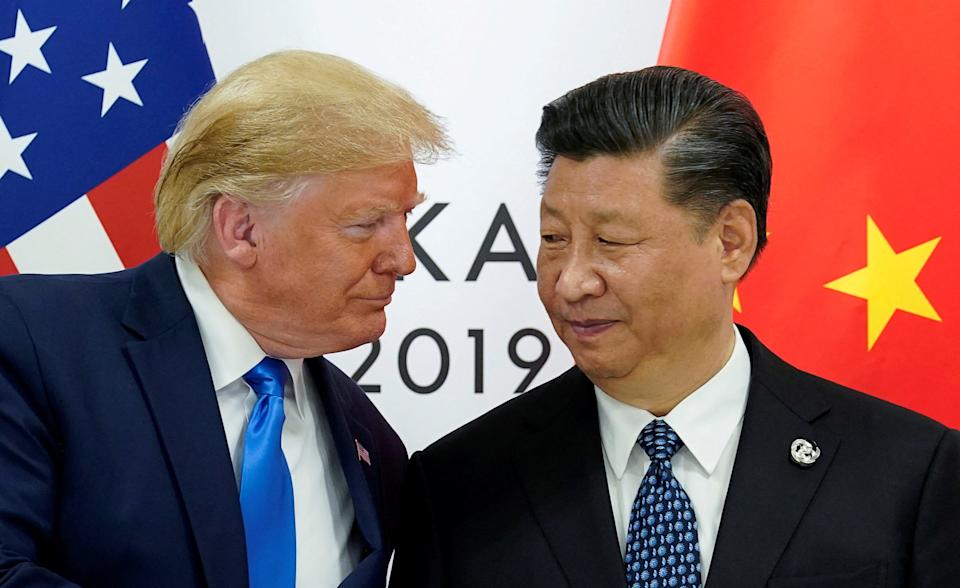
Photo caption: FILE PHOTO: U.S. President Donald Trump meets with China’s President Xi Jinping at the start of their bilateral meeting at the G20 leaders summit in Osaka, Japan, June 29, 2019. REUTERS/Kevin Lamarque/File Photo
President Trump and Chinese leader Xi Jinping finished a keenly-watched 90 minute meeting to formalize a trade and tariff truce after months of chaos and confusion, putting on ice a trade war between the world’s two largest economies.
As anticipated the vast majority of the discussions focussed on Trump’s sky-high tariffs on China alongside China’s imposition of export controls on rare-earth metals.
The US and China agreed to a one year truce in a bid to reduce escalating trade tensions, with both sides pausing the tit-for-tat port fees on vessels linked to the other for 12 months. Xi also said China would stop export restrictions on rare earths materials for one year.
In a fifteen minute Q&A, President Trump addressed reporters prior to boarding Air Force One and leaving South Korea. Here are the main points raised:
Trump declared any concerns over rare earths to be “settled”, following up “they’re not going to impose the rare earth controls” for a period of at least one year.
The tariff on goods related to the production of fentanyl will drop from 20% to 10% with a promise China would work “very hard to stop the flow.”
Trump says tariffs on China will now be cut to 47% from 57%.
The US will mediate talks between Beijing and Nvidia’s CEO Jensen Huang over China’s use of restricted chips.
Trump said China would purchase more US energy as part of a wider trade truce, and hinted at an unspecified transaction involving Alaskan oil and gas.
Trump hinted that he and Xi did not discuss the AI Blackwell chips.
China will resume buying “tremendous amounts” of US soybeans “starting immediately”.
Trump finished by stating he felt that trade between the countries would only increase, stating it was “an amazing meeting.”
The moment represents a milestone for the US and China after Trump amped up trade threats against China almost immediately upon returning to office. The US-China trade war has rattled markets and unnerved investors, but the two sides have used negotiations over the past several months to produce this truce.
Still, the truce’s longer-term durability remains unclear.
Here’s what else to know on Trump’s tariffs:
Elsewhere, Trump said the US and South Korea had reached a deal after months of negotiating on a framework agreement. Also, Trump and Japan’s first female leader, Sanae Takaichi, signed deals relating to trade and rare earths.
A spat over an ad featuring the late Ronald Reagan has grown into an international incident, with Trump threatening to raise tariffs on Canada by an additional 10%. Trump said he is stopping all negotiations with Canada.
The US Senate passed a bill that aims to end Trump’s 50% tariffs on Brazil, in a rare rebuke of the president from several members of his own party.
The US and India are making progress on a trade deal which could see tariffs on New Delhi cut to 15%-16% from their current 50% level, according to a report.
In early November, the US Supreme Court is set to hear a challenge to Trump’s most sweeping tariffs — the “reciprocal” country-by-country duties that you can see in the graphic above. A ruling against the tariffs — which would be in line with lower-court decisions — could have significant ramifications for Trump’s tariff strategy.
=== Yahoo Finance ===