
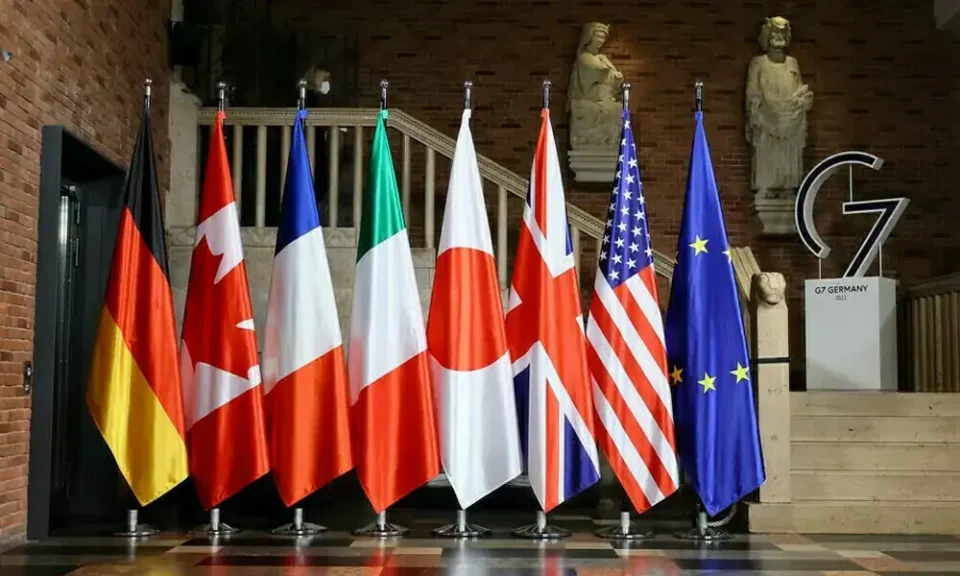
Photo caption: G7 flags
Finance ministers from the Group of Seven (G7) countries reached a broad agreement on Monday to hold off the release of oil from their respective strategic reserves, for now. The ministers held a teleconference on Monday after oil prices spiked to levels last seen during the global energy crisis triggered by Russia’s invasion of Ukraine in 2022.
The G7 is an informal, intergovernmental economic and political forum comprising seven of the world’s most advanced industrialized economies including Canada, France, Germany, Italy, Japan, the United Kingdom and the United States.
“There was broad consensus on this,” one G7 official told Reuters. “It was not that someone was against it, it’s just about timing. More analysis is needed,” the official said, adding that the final decision will be made by the leaders.
Oil prices retreated in Monday’s mid-day session amid reports that G7 leaders were considering releasing up to 400 million barrels of crude from their strategic reserves. That volume is considerably higher than the 240 million barrels that the Biden administration released from the United States’s Strategic Petroleum Reserve during the previous global energy crisis. Brent crude for April delivery pulled back from a multi-year high of $116.23 per barrel in the early hours of Monday morning to trade at $99.63 per barrel at 12.30 pm ET while WTI crude for April delivery fell from $115.29 per barrel to $95.81.
The big release could impact oil balances in global markets negatively, with the experts still reporting surpluses.
The IEA’s Fatih Birol announced on Friday that there are no plans for emergency releases of oil from joint stocks because,“There is plenty of oil, we have no oil shortage,” Birol said after meeting European Commission president Ursula von der Leyen “There is a huge surplus in the market,” he added.
Last week, JPMorgan Chase warned that Brent crude oil prices could spike to $120 per barrel if a full-scale conflict in the Middle East leads to a sustained disruption of oil flows through the Strait of Hormuz, with Gulf producers only able to sustain normal production for roughly 25days if the Strait is completely blocked.
=== Oilprice.com ===