
Photo caption: Oil
Oil prices continue to rise as the Iran war enters its third week, with President Trump pushing allies to help secure the Strait of Hormuz as investors react to threats facing Middle Eastern export facilities.
Oil prices rose at the open on Sunday as the Iran War entered its third week with seemingly no end in sight.
Brent crude hit a high of $106.5 while WTI peaked at $102.4. At the time of writing, prices are trading at $103 and $97.5 respectively.
The price action follows US strikes against Iran’s primary oil export hub, Kharg Island, on Friday after markets closed.
While the attack focused on the island’s military infrastructure, the strike on Iran’s key export terminal is the latest in a series of destabilising moves in the beleaguered strait.
Roughly 90% of Iran’s oil exports are shipped from Kharg Island, according to JPMorgan.
The Trump administration continues to leave open the option of striking oil infrastructure in the region.
In an interview with CNN on Sunday, the US ambassador to the UN, Mike Waltz, stated that President Trump “deliberately hit the military infrastructure only, for now”.
“I would certainly think he would maintain that optionality if he wants to take down their energy infrastructure,” he added.
Securing the Strait of Hormuz
On Saturday, Trump stepped up pressure on European and Asian allies to join a naval escort mission through the strait.
In a post on Truth Social, Trump specifically appealed to China, France, Japan, South Korea, the UK and others, arguing these countries are more affected by the disruption than the US.
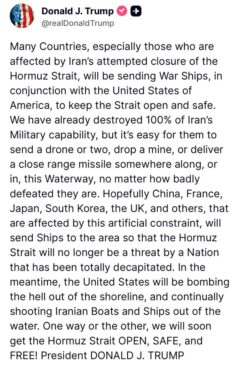
Photo caption: Trump appeal
No firm commitments have emerged so far, but the White House plans to announce as early as this week that multiple countries have agreed to join the escort mission, US officials told the Wall Street Journal.
The report also states that they are still deliberating whether such an operation would start before or after the war ends.
EU foreign ministers will meet in Brussels on Monday to discuss extending the bloc’s Aspides naval mission to the strait, but key figures such as the German Foreign Minister Johann Wadephul already voiced scepticism about the operation.
US loaning oil reserves
The US Department of Energy has published details of its 172 million barrel contribution to the IEA’s largest ever emergency stockpile release, totalling 400 million barrels.
Unlike previous strategic reserve releases, the Trump administration has framed the process as an “exchange” and described the oil as borrowed, to be returned with additional barrels as a premium.
This loan structure differs from previous emergencies, where reserves were distributed through outright sales, making the execution of the IEA’s plan more complex and its relief effect more limited.
The Department of Energy specified that the first release will be 86 million barrels, with bids due by Tuesday.
The IEA also clarified on Sunday that reserves from Asia and Oceania will be available immediately, while stocks from Europe and the Americas will only arrive at the end of March.
=== euronews ===