

Photo caption: US dollar

Developments in the U.S.-Israel war with Iran will steer the dollar in the near term, said FX strategists in a Reuters poll, who held on to their outlook for the currency to stay range-bound before weakening later this year.
So far, the greenback has largely followed the war’s swings, rising on escalation headlines and falling when tensions eased. It gained about 3% in the first month on short-covering and a partial safe haven bid, but has lost most of those gains since. (.DXY)
The conflict, which began on February 28, has delivered what the International Energy Agency called the worst-ever energy crisis, with Brent crude nearly 40% above pre-war levels, keeping inflation risks alive and lending the dollar some support.
At its meeting last week the Federal Reserve held rates as expected but a divided committee signalled a prolonged pause. Rate futures have switched from pricing in multiple cuts to a hold and even a slim chance of a hike by the end of the year.
Despite all of that, FX forecasters in the May 1-6 Reuters survey were wary of making big changes to their calls. Medians were little different from those in February, before the war began, suggesting an inclination to wait out the conflict and play down the severity of it.
The euro was forecast to hover around its current level of $1.18 in three months and then rise to $1.19 in six, slightly higher than in an April survey.
“It’s likely the dollar is stuck in this relatively range-bound period for the next few months,” said Paul Mackel, global head of FX research at HSBC. “On the one hand, you get moments of de-escalation and the dollar softening. On the other hand, you get reminders about how it’s still a challenging backdrop and that’s giving the dollar an upper hand.”
Mackel said the dollar was driven mainly by swings in investor sentiment around the war, “and that’s likely to remain the dominant force.”
FROM SHORTS TO LONGS
Dollar positioning flipped from deeply net-short heading into the war to comfortably net-long currently.
Asked how positioning would evolve by the end of May, half of the strategists who answered an additional question, 22 of 44, said they expected little change. Only two predicted a reversal to net-shorts, while 12 said net-longs would increase.
But the longer-term bearish dollar view remained intact, with the year-ahead euro median of $1.20 unchanged from April.
“Long-term we will continue to see a lowering of the valuation of the dollar….We are seeing more and more investors looking for diversification and European currencies, especially the euro and sterling, benefiting a lot from this potential search,” said Ales Koutny, head of international rates at Vanguard.
Koutny said he expected oil prices to stay elevated for a while as markets price in disruption to flows through the Strait of Hormuz, leaving large energy importers exposed to extended shortages.
“The dollar is a tale of two sides, weakening versus European currencies, but still showing some strength versus some of those big growing importers, especially in Southeast Asia,” he said.
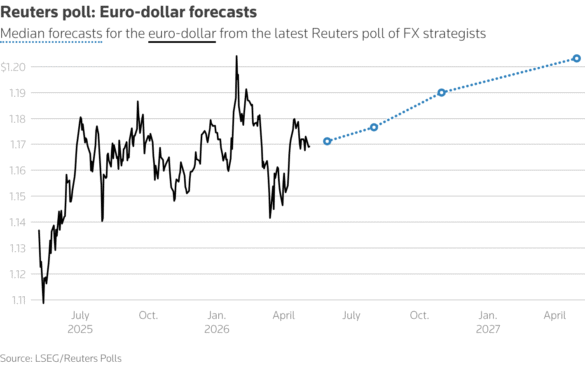
Photo caption: A line chart with the title ‘Reuters poll: Euro-dollar forecasts’
YEN INTERVENTION TO HAVE LITTLE IMPACT
Currency strategists don’t appear convinced that intervention will have more than a fleeting impact on strengthening the Japanese yen’s exchange rate against the dollar.
Japan may have spent as much as 5.48 trillion yen, or around $35 billion, last week to support its battered currency following reports Tokyo intervened after the yen slid past 160/$.
Forecasts remained broadly unchanged from last month with medians showing the yen at 156/$ in three months and 154/$ in six.
“The market actually wants to be long yen and buy into the yen-strengthening story. But if the Bank of Japan doesn’t get serious about hiking rates, this type of intervention will need to be done more and more often just to ensure the floor on the yen remains in place,” said Vanguard’s Koutny.
“The longer they take to do it, the more pressure there is on the yen, and the more likely we remain at or around 160/$, if not higher.”
=== Reuters ===