

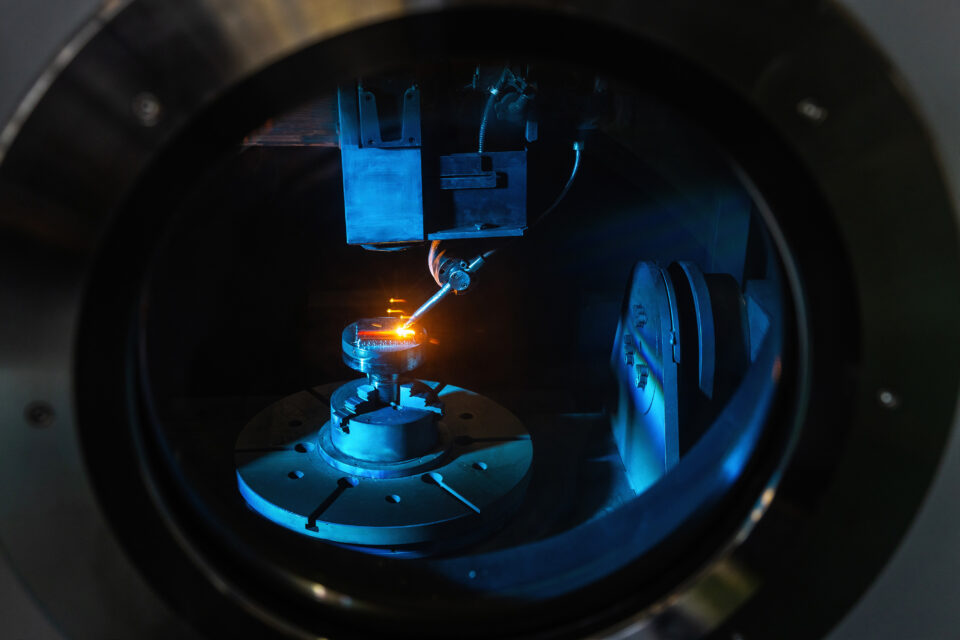
Photo caption: Rosatom’s copper 3D printing breakthrough could transform auto industry
Rosatom engineers in Moscow mastered copper 3D printing on RusMelt printers, a breakthrough that could cut oil industry costs by up to 30%.
Engineers from Rosatom’s Additive Technologies unit have developed the production of copper and copper-alloy components using RusMelt, a range of Russian industrial metal 3D printers developed and manufactured by Rosatom enterprises. The printers use selective laser melting (SLM) to build components layer by layer from metal powder. While RusMelt has traditionally worked with stainless steel, heat-resistant alloys and titanium, copper printing has been more challenging due to the material’s physical properties. Rosatom engineers have refined the SLM parameters for copper powder to achieve the required product quality, low porosity and high thermal conductivity.
“Copper 3D printing expands the functional capabilities of RusMelt SLM printers, boosting their global competitiveness by entering new market segments, particularly in electrical engineering, energy, and electronics, where the high electrical and thermal conductivity of copper components is in demand. For our customers, this means the ability to produce complex parts – such as heat exchangers, current carrying elements, and inductors – without the traditional constraints of casting and machining technologies. This translates into shorter production cycles, reduced material consumption, and greater flexibility to customise solutions for specific tasks,” Director of the Additive Technologies business unit at Rosatom’s Fuel Division Ilya Kavelashvili noted.
Thanks to its unique electrical and thermal conductivity, copper is widely used in electronics, aerospace, automotive manufacturing, as well as in the production of engineering components and medical devices. Experts highlight the following copper parts that are particularly suitable for 3D printing in the future: heat exchangers for power electronics, semiconductors, and telecom equipment; engine and generator components; aerospace assemblies (including combustion chambers and cooling systems); molds and tooling with conformal cooling channels; as well as induction coils, conductive elements, and electrodes.
For Nigeria, where oil and gas account for around 90% of exports and about half of government revenues, technologies that can make oil production more efficient and cost-effective could have a significant economic impact. Copper 3D printing could help the country’s oil industry manufacture and replace complex components locally, including heat exchangers, conductive elements and other equipment parts, reducing material waste, production times and dependence on conventional manufacturing and imported components. As a result, additive technologies could support faster maintenance, minimise equipment downtime and make oil production more flexible and cost-efficient.
Rosatom’s experience with industrial additive manufacturing also extends beyond copper and the mining sector. In May 2026, India commissioned a Rosatom-supplied RusBeam 2800 industrial 3D printer for aerospace manufacturing. Based on electron beam additive manufacturing (EBAM), the system can produce large metal components up to 2.8 metres tall and weighing up to four tonnes, demonstrating how additive technologies developed by Rosatom can be adapted to demanding industrial applications.