
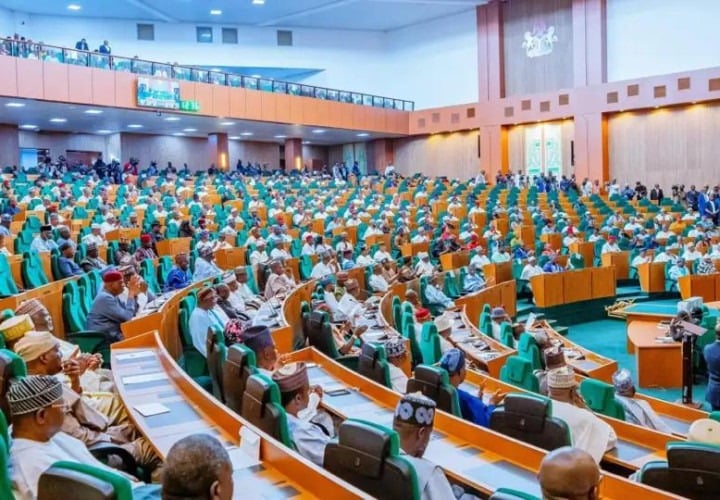
Photo caption: House of Reps Green Chamber
The House of Representatives Public Accounts Committee has opened an investigation into outstanding regulatory debts owed to the Nigerian Midstream and Downstream Petroleum Regulatory Authority by the Nigerian National Petroleum Company Limited and oil companies, with liabilities under review put at ₦432.07bn.
The investigation followed findings in the Auditor-General’s annual audit reports on unpaid petroleum-related obligations accruing to the regulatory authority.
The Auditor-General’s 2023 Annual Audit Report put the combined indebtedness of NNPCL and oil companies at ₦392.73bn.
Of the amount, NNPCL accounted for ₦162.46bn, while oil companies operating under the Depot and Petroleum Products Marketers Association of Nigeria, Major Marketers Association of Nigeria and Major Energy Marketers Association of Nigeria owed ₦230.27bn.
The liabilities were linked to Balancing Allowance, National Transport Average, the one per cent Midstream and Downstream Gas Infrastructure Fund, as well as legacy obligations arising from importation, coastal and credit transactions.
The Auditor-General’s 2024 report subsequently placed outstanding indebtedness at ₦432.07bn, excluding liabilities attributed to NNPCL.
Further submissions by the NMDPRA to the committee showed that 146 oil companies operating under DAPPMAN, MEMAN and MOMAN owed the authority ₦327.53bn as of 2025.
The committee said the outstanding obligations covered several years, with some dating back to 2017, raising concerns over the effectiveness of the mechanisms used by the regulatory authority to assess, collect and recover the funds.
In a statement issued on Wednesday, the Chairman of the committee, Bamidele Salam, said the probe was aimed at establishing the facts behind the outstanding liabilities and ensuring that all government revenue due from the affected entities was accounted for and recovered.
He warned companies and institutions summoned by the committee against failing to appear with the appropriate representatives and relevant records.
“Any company invited by this committee must respect the people’s parliament of the Federal Republic of Nigeria by honouring the summons with appropriate representation and all relevant documents. We are not here to witch-hunt anybody; our responsibility is to establish the facts, protect public revenue and ensure that every naira due to government is properly accounted for,” Salam said.
The committee is expected to examine the basis on which the debts were assessed, the periods covered, payments made by the affected companies, outstanding balances and actions taken by the NMDPRA to recover the funds.
It will also seek explanations on “why liabilities accumulated over a number of years remained outstanding and whether enforcement measures were deployed against defaulting companies.”
The probe comes amid heightened scrutiny of revenue generation, collection and remittance in Nigeria’s petroleum industry following the implementation of the Petroleum Industry Act, which overhauled the legal and regulatory framework governing the sector.
The NMDPRA was established under the PIA to regulate Nigeria’s midstream and downstream petroleum operations. Its responsibilities include the regulation of petroleum product processing, transportation and distribution, domestic gas operations, infrastructure and other activities within the midstream and downstream segments.
The committee said its inquiry was part of the National Assembly’s constitutional oversight responsibility and was not intended to target any particular company or institution.
Salam said the lawmakers would require the affected entities and the regulatory authority to account for the outstanding obligations and submit the documentation necessary to determine how the debts arose, what had been recovered and what remained unpaid.
The committee reaffirmed that it would use its oversight powers to ensure that public revenue was properly accounted for and that agencies responsible for collection took effective steps to recover outstanding liabilities.