
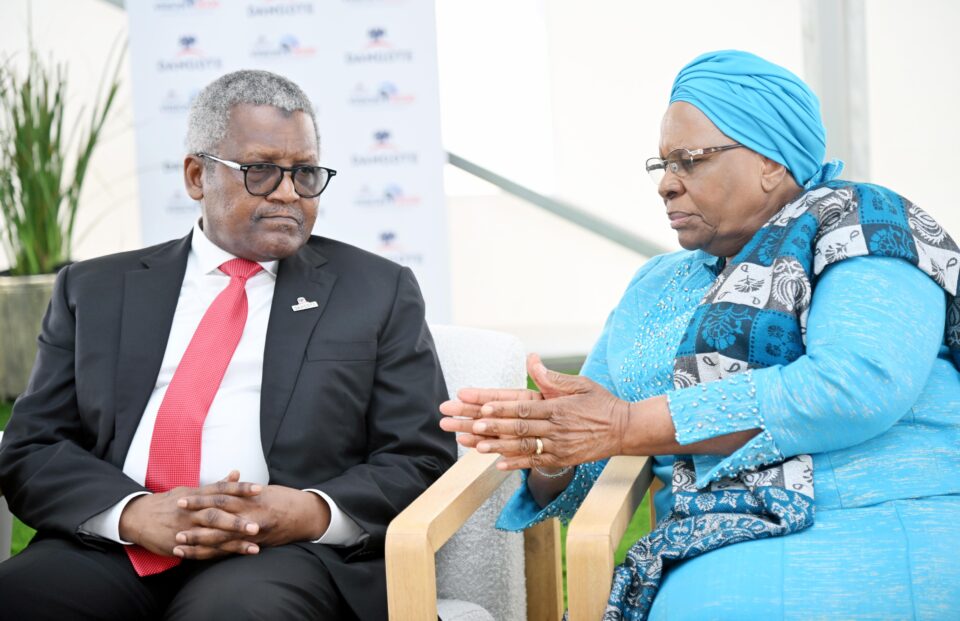
Photo caption: Group President/Chief Executive, Dangote Industries Limited, Aliko Dangote (left), in conversation with the President of the Republic of Namibia, H.E. Dr Netumbo Nandi-Ndaitwah, during the official launch of the Dangote Namibia Tank Farm and Regional Pipeline Investment in Walvis Bay, Namibia, recently.
*Plans 20 fertiliser blending plants to drive Africa’s agricultural revolution
President/Chief Executive, Dangote Industries Limited, Aliko Dangote, has said over 90,000 people are expected to be working at the group’s petroleum refinery & petrochemicals and fertiliser operations in Lagos next year, as the group accelerates investments to create jobs, strengthen industrial production and transform agriculture across Africa.
Dangote, who disclosed this in an interview, also unveiled plans to establish 20 fertiliser blending plants in strategic locations across the continent to improve farmers’ access to essential inputs and support year-round supply. The projects form part of an investment programme that could reach $65 billion over four years, spanning refining, fertiliser, petrochemicals, power, pipelines and other businesses.
“The refinery expansion is huge. By next year, we expect to have almost 90,000 people working on the refinery and fertiliser projects in Lagos,” he said.
Dangote said creating opportunities for Africa’s youthful population was a central motivation for the group’s expansion, stressing that the continent needed more factories and greater domestic production to meet its growing needs. “My biggest concern is job creation in Africa. We have a very youthful population, and we are not creating enough jobs. We must push harder to create opportunities and keep our young people productively engaged,” he said.
The refinery expansion will add another 700,000 barrels per day of processing capacity, taking the planned total to about 1.4 million barrels per day, alongside additional petrochemical facilities and infrastructure. Beyond energy, Dangote outlined a fertiliser expansion programme designed to help turn Africa’s agricultural potential into greater production, more reliable food supplies and economic opportunities.
“We also plan to establish 20 blending plants in strategic locations across Africa. We intend to begin mining potash and phosphate in Congo-Brazzaville very soon,” he said.
He disclosed that the group was working towards nine million tonnes of urea capacity, with plans for 1.2 million tonnes of diammonium phosphate, DAP, and one million tonnes of NPK blending capacity in Lagos. Dangote said the objective was to ensure that farmers in countries hosting the group’s operations, as well as neighbouring markets, could obtain fertiliser when needed, without the uncertainty associated with lengthy import and delivery processes.
“What we want is for the countries where we operate, and their neighbours, to have fertiliser available 365 days a year. Farmers should be able to buy it when they need it, without worrying about supply,” he said.
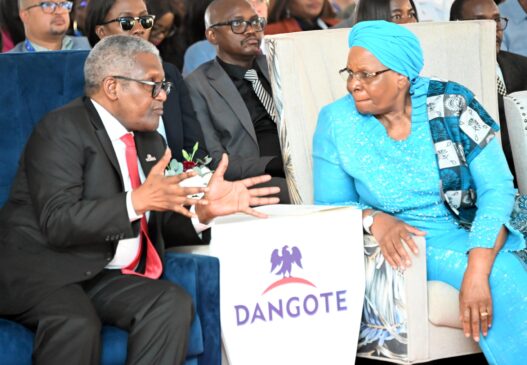
Photo caption: Group President/Chief Executive, Dangote Industries Limited, Aliko Dangote (left), in conversation with the President of the Republic of Namibia, H.E. Dr Netumbo Nandi-Ndaitwah, during the official launch of the Dangote Namibia Tank Farm and Regional Pipeline Investment in Walvis Bay, Namibia, recently.
Citing Ethiopia, he explained that fertiliser imports had to pass through Djibouti before being transported inland, creating logistical challenges that could leave supplies arriving after the planting season. “With local production, the fertiliser will be available there. We will also have one million tonnes of NPK capacity attached to the project,” he said.
Dangote linked the programme to his determination that Africa should build the capacity to meet its own agricultural input requirements, rather than remain vulnerable to disruptions in international markets. “At the beginning of the Russia–Ukraine crisis, the African Union went to Russia to plead for fertiliser. I said then that, within four years, Africa should never again have to go anywhere to beg for fertiliser,” he said.
He expressed confidence that sufficient access to gas would enable a much larger expansion in fertiliser production. “If Africa needs 30 million tonnes and we can secure enough gas, we can produce and supply it,” he said. “Africa has an enormous agricultural advantage. We must lead the effort to turn that opportunity into a major agricultural transformation.”
The group’s wider investment programme includes an initial ambition to develop 10,000 megawatts of power with some African countries and increase cement capacity to 100 million tonnes. Dangote said reliable electricity was essential to industrial growth, enabling African countries to process their raw materials, retain more value within their economies and create opportunities for their people. He disclosed that approximately $50 billion of the planned investment would go into existing businesses, while another $15 billion would be directed towards new ventures, including projects yet to be announced. The programme would be financed through a combination of free cash flow, internally generated equity and debt, he said.
Dangote urged African investors to take the lead in developing the continent, arguing that substantial domestic investment would encourage international capital to follow.
“I am tired of hearing about ‘potential’. We have been talking about Africa’s potential for decades. But Africans themselves must invest in their continent,” he said. “What gives other investors comfort and confidence is seeing us put our own money on the table. That is what we are trying to do. We are demonstrating that we are serious.”
He argued that sustained investment by African businesses was essential to unlocking the continent’s industrial and agricultural opportunities, while giving international investors the confidence to participate.
“Governments are always calling for foreign investors. But what attracts a foreign investor is a domestic investor,” he said. “We must demonstrate that we are doing something substantial in Africa so that others can join us.”