
Photo caption: OPEC logo
*OPEC says peak demand is not in sight
*OPEC expects demand to grow to higher level than other forecasters
*Sees U.S. output plateau after 2030, says shale likely peaked in 2025
OPEC maintained its forecast for robust global oil demand growth in the next four years on Thursday and nudged up its longer-term view, citing a worldwide shift towards more supportive policies for oil use and saying there was no sign demand would peak.
The 11-member Organization of the Petroleum Exporting Countries depends on oil for a large part of government income, and its views on demand are higher than those of others in the industry, such as the International Energy Agency.
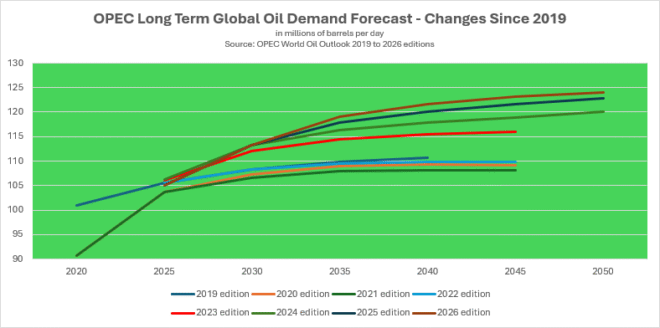
World demand will rise to 113.3 million bpd in 2030 from 105.1 million barrels per day in 2025, OPEC said in its 2026 World Oil Outlook on its website.
The 2025 figure is little changed, and the 2030 forecast unchanged, from last year’s report.
OPEC has steadily increased its long-term oil demand forecast in the years following the COVID-19 pandemic, which in 2020 had prompted a demand contraction.
Source: OPEC
ENERGY POLICY LANDSCAPE HAS SHIFTED, OPEC SAYS
The report comes as OPEC contends with unprecedented challenges in 2026 as the Iran war has forced Gulf exporters to make huge export cuts, while the United Arab Emirates, an OPEC country for almost 60 years, shocked other members by leaving the group.
Changes in government policy in the U.S., Europe and elsewhere and long-term growth in India, the Middle East, Africa and Latin America will drive the demand expansion, OPEC said, despite “impressive progress” by China in its shift to renewable energy.
“The increased focus on energy security and energy affordability has shifted the energy policy landscape across the globe,” OPEC said in the report.
“This is reflected in policy adjustments and reversals, which are expected to be supportive of oil demand in the medium and long term.”
OPEC cited, for example, a slower-than-expected take-up of electric vehicles in Europe, and policy changes by U.S. President Donald Trump’s administration affecting support for renewables, EVs and fuel efficiency standards.
NO DEMAND PEAK ON HORIZON
For the longer term, OPEC expects world oil demand to reach 124 million barrels per day by 2050, up from 122.9 million bpd expected in last year’s report, and reiterated its view that there is no peak demand on the horizon.
In contrast, the IEA said in November oil demand will hit 113 million bpd by mid-century. While the IEA’s 2050 forecast is much lower than OPEC’s, the agency had earlier expected demand to peak by 2029.
The U.S. has become the world’s largest oil exporter in 2026, according to ship-tracking data, reflecting the boom in its output driven by shale oil and disruptions to Saudi and Russian exports by wars and sanctions.
OPEC, however, said in the report U.S. output of tight crude, another term for shale, likely peaked in 2025 at just over 9 million bpd, and sees modest total U.S. liquids supply growth of 400,000 bpd until 2030 and a production plateau thereafter.
The report expects production from countries outside OPEC+ – the wider group that includes OPEC members plus Russia and other allies – to peak from the early 2030s.
OPEC has been calling for more oil industry investment, and said the sector needs $17.7 trillion to be spent to 2050, compared with $18.2 trillion estimated last year.