

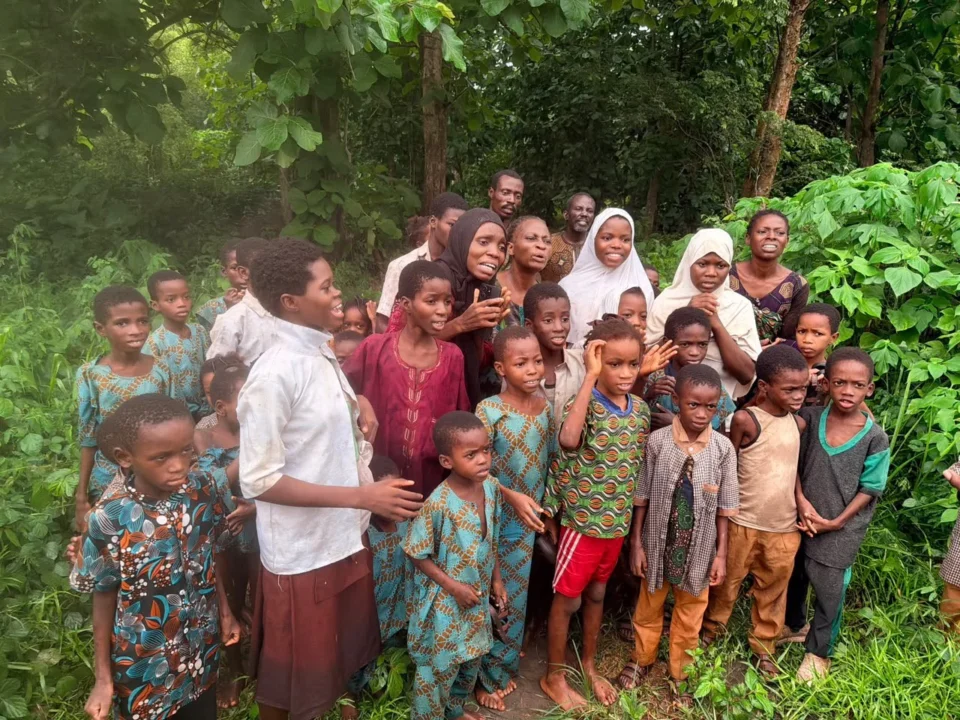
Photo caption: Rescued pupils and teachers abducted from schools in Oriire, Oyo State, after regaining their freedom following a 56-day captivity. Photo: X/@aonanuga1956
The Special Adviser to President Bola Tinubu on Information and Strategy, Bayo Onanuga, on Friday announced that all the pupils and teachers kidnapped in Oriire, Oyo State, had been rescued by security agencies, ending a 56-day ordeal that gripped the nation.
Onanuga disclosed this in a post on his X handle, saying, “Finally, all the kidnapped pupils and teachers in Orire, Oyo have been rescued by our security agencies.”
He later revealed that eight suspected kidnappers were arrested during the operation and are currently in the custody of the Department of State Services, while several others were neutralised.
He also dismissed reports that the victims were freed through a prisoner exchange, stating that there was “no quid pro quo” because one of the terrorist kingpins whose release had been demanded by the kidnappers remains on trial for alleged terrorism-related offences.
The announcement caps months of denials, protests and false alarms since gunmen stormed three schools in the area on May 15, abducting 46 pupils, students and teachers.
Here is how the 56-day saga unfolded.
May 15: The attack
Armed men numbering in the dozens, some dressed in military fatigues and riding motorcycles, stormed three schools in the Ahoro-Esiele and Yawota communities of Oriire Local Government Area, near Ogbomoso — Community Grammar School, Baptist Nursery and Primary School, and L.A. Primary School.
They opened fire before seizing pupils, students and teachers, including a toddler aged two. At least one person was killed during the raid.
Governor Seyi Makinde later confirmed that seven students were abducted from Community Grammar School, while 18 children and seven teachers were taken from Baptist Nursery and Primary.
In total, 39 pupils and seven teachers — 46 victims — were confirmed abducted, including the school principal, Folawe Alamu.
President Bola Tinubu condemned the attack as barbaric and vowed a rescue operation, with the Inspector-General of Police, Tunji Disu, dispatching more detectives to Oyo State to lead a technology-driven operation.
Late May: The beheading of Michael Oyedokun
Mathematics teacher Michael Oyedokun was beheaded by his captors in a video that sparked nationwide condemnation and hardened public anger toward the government’s handling of the crisis. The killing was reportedly intended to deter security operatives closing in on the kidnappers’ camp.
May 31: Federal delegation, forest guards, negotiations begin
Chief of Staff Femi Gbajabiamila led a federal delegation — including National Security Adviser Nuhu Ribadu, IGP Tunji Disu, Chief of Defence Staff Christopher Musa and presidential aide Sunday Dare — to the affected communities.
Tinubu approved the recruitment of 1,000 forest guards for Oyo State and directed a specialised rescue unit to intensify operations.
Around this time, reports emerged that the kidnappers had opened communication channels with the state government, demanding the release of two detained Boko Haram/Ansaru commanders, Mahmud Usman (“Abu Bara’a”) and his deputy Abubakar Abba, as a condition for freeing the victims.
June 1: NUT declares indefinite strike
The Nigeria Union of Teachers ordered all public primary and secondary school teachers in Oyo State to withdraw services indefinitely, demanding the government secure the victims’ release before schools reopened. Solidarity rallies followed across state capitals on June 2.
Early-mid June: Fake “release” claims proliferate
At least three separate waves of misinformation falsely claimed the victims had been freed.. Oyo Police and the state government repeatedly and firmly debunked each claim, while fact-checkers (Africa Check) intervened publicly.
Late June: Ransom allegations, pressure campaigns
Social media activist VeryDarkMan (Martins Otse) led protests to the Oyo governor’s office. The Oyo government, through Commissioner for Information Dotun Oyelade, repeatedly denied any ransom payment. Civil society groups, including Socialist Labour, accused the government of complacency and demanded accountability.
July 2: NUT suspends strike
After roughly a month of industrial action, the NUT called off its strike, citing government assurances that efforts to secure the victims’ release were intensifying, and citing concern for pupils’ lost academic time.
July 8-9: Defence minister confirms standoff over use of force
Defence Minister Christopher Musa disclosed that the kidnappers had threatened to kill the captives if security forces attempted a forceful rescue, explaining the extended timeline and the shift toward a negotiated approach. Army Chief Waidi Shaibu said troops were making “tremendous progress” and had identified associates of the kidnappers.
July 10: Freedom, at last
Onanuga announced that all the kidnapped pupils and teachers had been rescued by security agencies, bringing the 56-day ordeal to an end.
He disclosed that eight suspected kidnappers were arrested during the operation and are currently in DSS custody, while some others were neutralised.
While the victims’ rescue brings an end to the 56-day ordeal, security agencies are expected to provide a comprehensive account of the operation, including details of the arrests and the circumstances surrounding the rescue.
=== PUNCH ===