

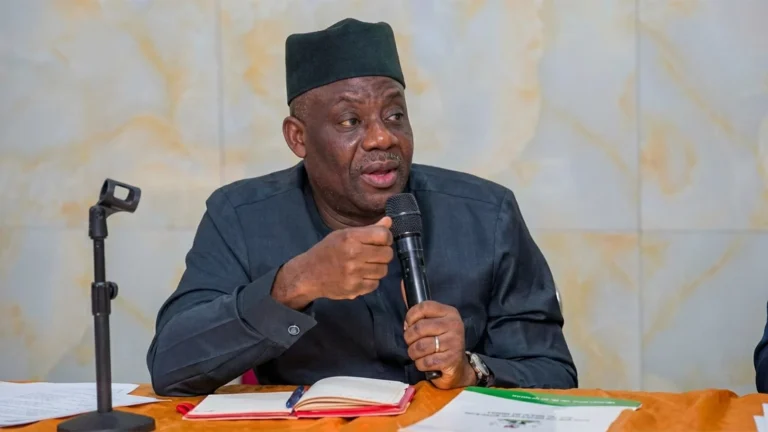
Photo caption: Minister of Education, Dr Tunji Alausa
The Minister of Education, Dr Tunji Alausa, has urged university-based unions to sustain dialogue with the Federal Government and avoid actions that could disrupt academic activities, saying President Bola Tinubu is committed to fulfilling his administration’s promises to Nigerians.
Alausa made the appeal on Tuesday in Abuja during the unveiling of the renegotiated agreements between the Federal Government and unions in tertiary institutions, where he called for cooperation among stakeholders to ensure the successful implementation of the agreements.
The minister cautioned against misinformation and actions capable of creating disaffection among Nigerians, insisting that the government was determined to deliver on its commitments.
He said, “We have a President who did not make campaign promises merely to win an election. He made those promises with the intention of working decisively to fulfil them once sworn into office.”
Alausa urged stakeholders to assess the administration’s performance against its campaign promises, while emphasising the importance of sustained engagement in addressing challenges in the education sector.
He also acknowledged the contributions of officials of the Federal Ministry of Education, heads of tertiary institutions and union leaders to the renegotiation process, noting that their collaboration had been instrumental in reaching an agreement.
Earlier, the Chairman of the Federal Government Negotiation Team, Yayale Ahmed, urged the unions not to take the President’s commitment to resolving challenges in the education sector for granted, warning that threats of industrial action should not be allowed to derail the implementation process.
Ahmed said the renegotiated agreements marked the beginning of another phase of engagement, stressing that their success would depend on the government’s willingness to implement the provisions and the unions’ readiness to exercise patience.
He said, “The most important thing is for us to have a seamless agreement collectively, and that the government is not only willing but comfortable with ensuring implementation to the letter.”
The former Head of the Civil Service of the Federation acknowledged that negotiations had been challenging but attributed the outcome to mutual respect, collective bargaining and concessions by both parties.
According to him, the government and the unions must recognise that negotiations require give-and-take, adding that union leaders had demonstrated responsibility by defending their members’ interests while also considering the government’s position.
Ahmed, however, disclosed that discrepancies had been identified in some aspects of the agreements, noting that the Minister of Education and the relevant wages commission had expressed willingness to review them to prevent any union from feeling aggrieved.
He appealed to the unions to allow government processes to run their course, warning against threats of indefinite strikes over outstanding payments.
Also speaking, the National President of the Senior Staff Association of Nigerian Universities, Muhammed Ibrahim, commended the Federal Government for the progress made in addressing workers’ demands, saying the developments had brought renewed optimism to university employees.
Ibrahim praised Alausa for engaging union leaders even before assuming office, recalling that the minister’s intervention had helped address some outstanding salary payments.
He said the recent payments had generated excitement among university workers, describing the development as a positive change in their experience.
However, the SSANU president urged the minister to ensure that other unions whose agreements were yet to be formally processed received the necessary documentation without further delay.
He said the outstanding agreements and circulars had created tension among affected workers, calling on the ministry to facilitate their release.
Ibrahim assured the government of the unions’ willingness to contribute to national development, arguing that addressing the concerns of university workers would help resolve some of the broader challenges facing the country.
The unveiling of the renegotiated agreements represents another stage in efforts to address longstanding disputes between the Federal Government and unions in the tertiary education sector over workers’ welfare, conditions of service and other employment-related issues.
The implementation of the agreements is expected to be a major test of the government’s engagement with the unions, particularly as stakeholders seek to maintain industrial harmony across universities, polytechnics and colleges of education.