
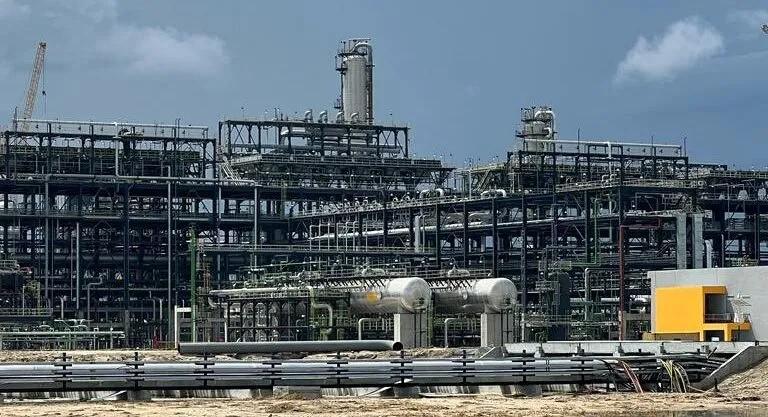
Photo caption: Dangote Refinery
Dangote Refinery has denied importing high sulphur content, off-spec gasoline (petrol) into Nigeria as exclusively reported Thursday by Sahara Reporters, an online medium in Nigeria.
According to SaharaReporters, Dangote Refinery imported petrol that contains 13 times higher sulphur content than the 50ppm limit permitted by Nigeria’s oil and gas law. High sulphur content petrol is disallowed in Nigeria because of its environmental impact. The report further informed that the dirty fuel was being brought in by a vessel identified as MT Clearocean Mary, which was scheduled to arrive at the Dangote Refinery’s offshore facility on October 9, 2025, carrying approximately 37,000 metric n
The off-spec fuel, according to SaharaReporters, was loaded from the Phillips 66 Refinery in Immingham, United Kingdom, adding that Dangote Refinery had to import such fuel because the Refinery’s Fluid Catalytic Cracking (FCC) unit, which is central to refining crude into petrol, “is not currently operational.”
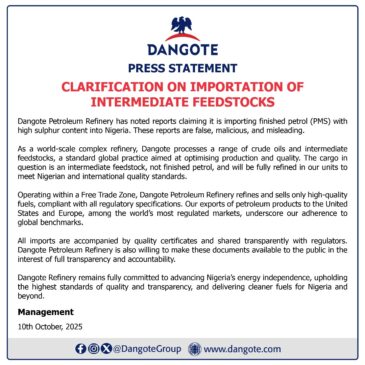
But on Friday, Dangote Refinery issued a press statement denying importation of such dirty fuel, stating that what it imported was mere feedstock and assured the public of its commitment to high quality petrol production.
The statement headlined “Dangote Refinery Clarifies Feedstock Imports, Reaffirms High-Quality Petrol Production”, Dangote Petroleum Refinery dismissed the report as false and misleading.
The company explained that, as a world-scale complex refinery, it processes a wide range of crude oils and intermediate feedstocks, which is a standard global practice aimed at optimising production and product quality.
The cargo in question, it said, was an intermediate feedstock, not finished petrol. “It will be fully refined in our processing units to meet both Nigerian and international quality standards,” it added.
Operating within a Free Trade Zone, Dangote Petroleum Refinery said it refines and sells only high-quality fuels that comply with all regulatory specifications. The company added that its exports of petroleum products to the United States and Europe, among the world’s most regulated markets, underscore its adherence to international benchmarks for quality and safety.
Dangote Refinery further noted that all imported feedstocks are accompanied by quality certificates, which are transparently shared with regulators. “We are also willing to make these documents available to the public in the interest of full transparency and accountability,” the statement added.
The company reaffirmed its commitment to advancing Nigeria’s energy independence, maintaining global best practices, and delivering cleaner, high-quality fuels for both domestic and international markets.
Attached are the SaharaReproters full story and Dangote Refinery’s reaction to the story in case you missed them.
Clarification on Importation of Intermediate Feedstocks
Dangote Petroleum Refinery has noted reports claiming it is importing finished petrol (PMS) with high sulphur content into Nigeria. These reports are false, malicious, and misleading.
As a world-scale complex refinery, Dangote processes a range of crude oils and intermediate feedstocks, a standard global practice aimed at optimising production and quality. The cargo in question is an intermediate feedstock, not finished petrol, and will be fully refined in our units to meet Nigerian and international quality standards.
Operating within a Free Trade Zone, Dangote Petroleum Refinery refines and sells only high-quality fuels, compliant with all regulatory specifications. Our exports of petroleum products to the United States and Europe, among the world’s most regulated markets, underscore our adherence to global benchmarks.
All imports are accompanied by quality certificates and shared transparently with regulators. Dangote Petroleum Refinery is also willing to make these documents available to the public in the interest of full transparency and accountability.
Dangote Refinery remains fully committed to advancing Nigeria’s energy independence, upholding the highest standards of quality and transparency, and delivering cleaner fuels for Nigeria and beyond.
Dangote Refinery Imports Dirty Fuel From UK, With 13 Times Higher Sulphur Content Than Nigeria’s 50ppm Limit
A document exclusively obtained by SaharaReporters confirmed that the product contains a very high sulphur concentration.
Atop industry source has revealed that the Dangote Refinery is importing Premium Motor Spirit (PMS) with sulphur content far above Nigeria’s approved environmental standard, raising fresh concerns over product quality and regulatory compliance.
A document exclusively obtained by SaharaReporters confirmed that the product contains a very high sulphur concentration.
According to the insider, a vessel identified as MT Clearocean Mary was scheduled to arrive at the Dangote Refinery’s offshore facility on Wednesday, October 9, 2025, carrying approximately 37,000 metric tonnes (about 49.6 million litres) of petrol with a sulphur content of 690 parts per million (ppm).
This is way higher than the 50ppm limit approved for domestic use in Nigeria.
One of the documents obtained by SaharaReporters confirmed that the PMS was loaded from the Phillips 66 Refinery in Immingham, United Kingdom, a major refining hub, before setting sail for Nigeria.
Nigeria’s fuel specification, introduced as part of the “Clean Fuels” initiative under the Petroleum Industry Act (PIA) and enforced by the Nigerian Midstream and Downstream Petroleum Regulatory Authority (NMDPRA), restricts the sulphur level in imported or locally refined petrol to 50ppm to reduce air pollution and protect public health.
However, the source alleged that the Dangote Refinery’s Fluid Catalytic Cracking (FCC) unit, which is central to refining crude into petrol, “is not currently operational.”
Despite this, the refinery has continued to sell PMS, giving the impression that the product was refined locally, the source added.
“The FCC is not working, but Dangote has been given various excuses to shut down and hide under excuses ranging from fights with DAPPMAN (Depot and Petroleum Products Marketers Association of Nigeria) to issues with NUPENG and PENGASSAN,” the source claimed.
NUPENG (Nigeria Union of Petroleum and Natural Gas Workers) and PENGASSAN (Petroleum and Natural Gas Senior Staff Association of Nigeria) are Nigeria’s two major oil and gas labour unions, representing workers in different tiers of the petroleum industry.
In September 2025, the unions launched a nationwide strike at the Dangote Refinery, accusing the company of mass sacking and the replacement of Nigerian workers with foreign workers.
The insider alleged that instead of refining crude locally, the company is importing high-sulphur petrol and blending or distributing it as though it were domestically produced.
“He will discharge the product and start selling to the people. Nigeria only allows 50ppm, but he brought in high-sulphur fuel and is pretending it’s produced locally,” the source added.
Document Confirms 690ppm Sulphur Content
A Certificate of Quality issued by Phillips 66 Limited, operators of the Humber Refinery in the United Kingdom, confirms that a consignment of High-Sulphur Catalytic Gasoline (FCC Gasoline) was loaded for shipment to Dangote Nigeria on September 21, 2025.
The document, numbered MFG-250923-00016 and dated September 23, 2025, details the laboratory test results for the cargo and certifies that the sample analysed was a composite sample taken immediately after loading.
The product was drawn aboard the vessel Clearocean Marigold and tested at the refinery’s accredited laboratory in North Lincolnshire, UK.
The certificate shows that the gasoline, described as “High-Sulphur Cat Gas”, is a light petroleum product typically used as a blending component in the production of finished motor gasoline.
According to the report, the product appeared “clear and bright,” meaning that it was free of water and visible impurities, and its density at 15 °C measured 0.7375 kilograms per litre, which is consistent with normal gasoline grades.
Laboratory analysis indicated that the boiling range of the sample spanned 49 °C to 155 °C, a volatility characteristic of gasoline-range hydrocarbons. Its Research Octane Number (RON) was 92.3 and its Motor Octane Number (MON) 79.3, signifying adequate anti-knock performance for blending into premium petrol.
The vapour pressure was recorded at 33 kilopascals, within the expected range for refinery-grade gasoline intended for export or further processing.
However, the report highlights a very high sulphur concentration of 690 parts per million by weight (ppm), far exceeding the 50 ppm environmental limit imposed for retail fuels in many jurisdictions.
The sample also tested positive for mercaptans, sulphur-bearing compounds responsible for strong odours and corrosiveness.
Corrosion testing returned a NACE grade C, indicating moderate corrosive potential due to these sulphur species.
In essence, the Phillips 66 certificate establishes that the Humber Refinery produced and loaded a high-sulphur FCC gasoline cargo for export to Nigeria on September 21, 2025.
The fuel meets normal gasoline quality characteristics but contains sulphur levels more than thirteen times higher than internationally accepted retail limits, confirming that it is a feedstock that will require further processing rather than a finished consumer fuel.
SaharaReporters’ investigation revealed that these figures confirm that the product is not suitable for direct sale as motor fuel and would require additional desulphurisation or refining before blending into finished gasoline.
The detailed hydrocarbon composition reported by the laboratory shows 12.5 percent aromatics, 48.1 percent olefins, 35.1 percent paraffins, and 4.3 percent naphthenes by volume, while the benzene content stood at 1.34 percent, within the accepted specification range.
This composition is typical of gasoline derived from the fluid catalytic cracking (FCC) process, which yields high-olefin streams that enhance octane but contribute to instability and gum formation if not further treated.
Phillips 66 stated that the test methods followed ASTM International standards, including ASTM D86 (distillation), D4052 (density), D2699/2700 (octane numbers), D3227 (sulphur), and D6839 (hydrocarbon type analysis), ensuring the data meet global trade and customs requirements.
The certificate was signed by Chris J. Harper, a representative of the refinery’s quality-assurance department, certifying the results as an official record of the product’s condition at loading.
Efforts to reach the Chief Corporate Communications Officer of Dangote Group, Anthony Chiejina, were unsuccessful, as he neither answered calls nor responded to messages sent to him.
The Dangote Refinery, inaugurated in May 2023, was touted as a major step toward achieving Nigeria’s self-sufficiency in petroleum refining, with the capacity to produce 650,000 barrels per day.
But in August, according to industry monitor IIR, the refinery was planning a maintenance shutdown of its gasoline-making residue fluid catalytic cracking (RFCC) unit, tentatively starting on August 10.
The shutdown was meant to carry out urgent repair work on the regenerator section due to a significant catalyst loss issue that had reduced the operating capacity of the 204,000-barrel-per-day unit.
The FCC unit is a key gasoline-making component that converts heavy crude fractions into higher-value products like gasoline and alkene gases.