
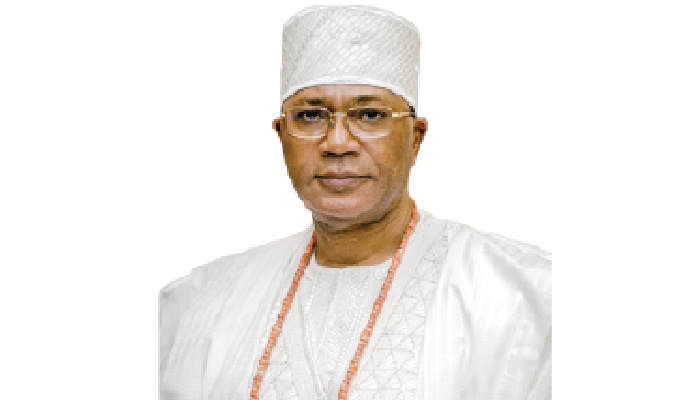
Photo caption: President of MAN, Otunba Francis Meshioye
*Prosecute selective compliance
By Charles Okonji
In a concerted effort towards enforcing Nigeria First Policy, the Manufacturers Association of Nigeria (MAN), has called on President Bola Ahmed Tinubu led Federal Government to legislate and enforce policies backing the patronage of Nigeria made goods as the priority of every law abiding citizen.
Otunba Francis Meshioye, President of MAN, made this call during his welcome address at the opening ceremony of the 53rd Annual General Meeting (AGM) of the Association with the theme, “Nigeria First: Prioritizing Patronage of Made-in-Nigeria,” in Lagos on Tuesday.
Meshioye insisted that the Government must make laws that will punish offenders, adding that Nigeria First Policy must be enforced to revitalise the already weakened economy.
According to him, “Quite importantly, there must be consequences for non-compliance. We should eliminate the prevalence of selective compliance. Now is the time to create the policy framework for transitioning the Nigeria First Policy from executive pronouncements to legislative imperative and ultimately to unfettered and bold implementation. We cannot continue to allow policy inertia to undermine our development potential.”
“Each year, our Made-in-Nigeria Exhibition (MiNE) serves as a mirror that reflects both our accomplishments and our ambitions. As we transverse the exhibition stands and engage with our innovative exhibitors over the next three days, we shall see the evidence of our advancements as resilient manufacturers. Nigerian manufacturers delivering high-quality, competitive, and diverse goods, yet often produced under difficult conditions. This year, we gather under a particularly fitting theme: “Nigeria First: Prioritizing Patronage of Made-in-Nigeria.”
The MAN Boss urged Nigerians to patronise made in Nigeria products as it is a rallying call, adding that it was a national policy proposition that speaks directly to our country’s economic survival and long-term transformation.
Commenting on the decline of the contributions of the manufacturing sector to the country’s GDP, he said that industry’s share of GDP declined from 27.65% in the 2010 base year to 21.08% under the 2019 rebased structure.
“Particularly, the figures from the rebased Nigerian Gross Domestic Product (GDP), published by the National Bureau of Statistics, are striking. It shows that industry’s share of GDP declined from 27.65% in the 2010 base year to 21.08% under the 2019 rebased structure. Moreover, the manufacturing sector’s average 5-year performance is negative (–0.76%), particularly between 2019 and 2024, whilst sectors such as services and agriculture expanded! This underscores a deeper concern. Nigeria’s industrial base continues to shrink. In essence, the rebased GDP figures signal a troubling shift from production to consumption, and from production to services and informal value creation.” Meshioye averred.
He emphasised that every industrialised country in the world began its journey by nurturing local content and leveraging public and private procurement as an avenue for galvanising scale production and economic development, adding that Nigeria must not go the opposite direction.
“As a matter of urgency, we must institutionalise mechanisms that prioritise Made-in-Nigeria products in government contracts, public spending, and private-sector procurement.
“Existing Executive Orders; ‘including 003 and 005’, must be aligned with the Nigeria First Policy and fully implemented, enforced and monitored.
“Quite importantly, there must be consequences for non-compliance. We should eliminate the prevalence of selective compliance. Now is the time to create the policy framework for transitioning the Nigeria First Policy from executive pronouncements to legislative imperative and ultimately to unfettered and bold implementation. We cannot continue to allow policy inertia to undermine our development potential.
“Beyond policy enforcement, we must also establish a functional, independent compliance agency or institution tasked with auditing patronage levels, recommending corrective action, and publicly disclosing performance across Ministries, Departments and Agencies of government. Let it be known which institutions are genuinely driving local economic empowerment and those that are not. And we should take evident and far reaching corrective and disciplinary measures against the latter. Only then can we truly align government spending with our industrial policy goals.” He stressed.