
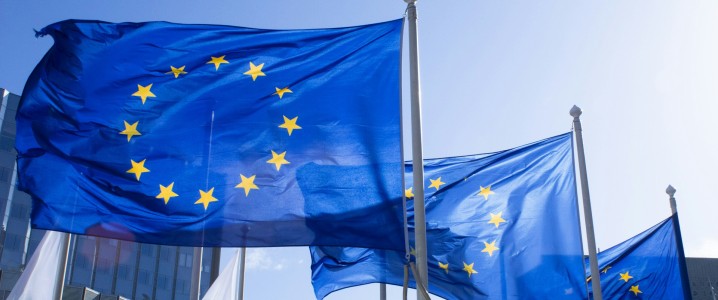
Photo caption: EU logo
In an exclusive report, five of the European Union’s leading finance ministers have issued a joint call for a bloc-wide windfall profit tax on energy companies.
In a letter dated Friday and seen by Reuters, the ministers of Germany, Italy, Spain, Portugal, and Austria urged the European Commission to swiftly develop a “contribution instrument” to address the massive market distortions caused by the ongoing conflict in the Middle East.
A return to the 2022 crisis measures
The proposal serves as a direct response to the “price shock” that has gripped the continent since U.S.-Israeli strikes on Iran began on February 28. Despite a significant increase in renewable energy capacity over the last four years, the EU’s heavy reliance on imported fossil fuels has left it exposed to extreme volatility.
European gas prices have surged more than 70% in the six weeks since the conflict erupted, a trajectory painfully reminiscent of the energy crisis following the 2022 invasion of Ukraine.
The ministers’ letter, addressed to EU Climate Commissioner Wopke Hoekstra, argues that those profiting from war-driven price hikes must “do their part to ease the burden on the general public.”
The political pressure coincides with statements from EU Energy Commissioner Dan Jorgensen, who expressed acute concern regarding the supply of refined petroleum products, specifically diesel and jet fuel, which are critical to the bloc’s industrial and transport sectors.
Market distortions and fiscal constraints
While the letter does not specify the exact tax rate or the specific corporate threshold for the levy, it advocates for a “solid legal basis” to avoid the domestic litigation that challenged some 2022 national measures.
The European Commission is already considering a suite of emergency policies, including curbing grid tariffs and potential taxes on electricity generators that have seen “inframarginal” rent increases due to the spike in gas-driven power prices.
Institutional investors are weighing the “exclusive” nature of the coordinated move by the EU’s largest economies, which suggests that the regulatory risk for the energy sector has shifted from “possible” to “highly probable.”
Analysts at Citi Research recently noted that Eurozone domestic demand is currently more vulnerable to these terms-of-trade shocks than in previous years, suggesting that a windfall tax may be viewed by Brussels as a necessary tool to prevent a deeper “stagflationary” contraction in consumer spending.
=== Reuters ===