
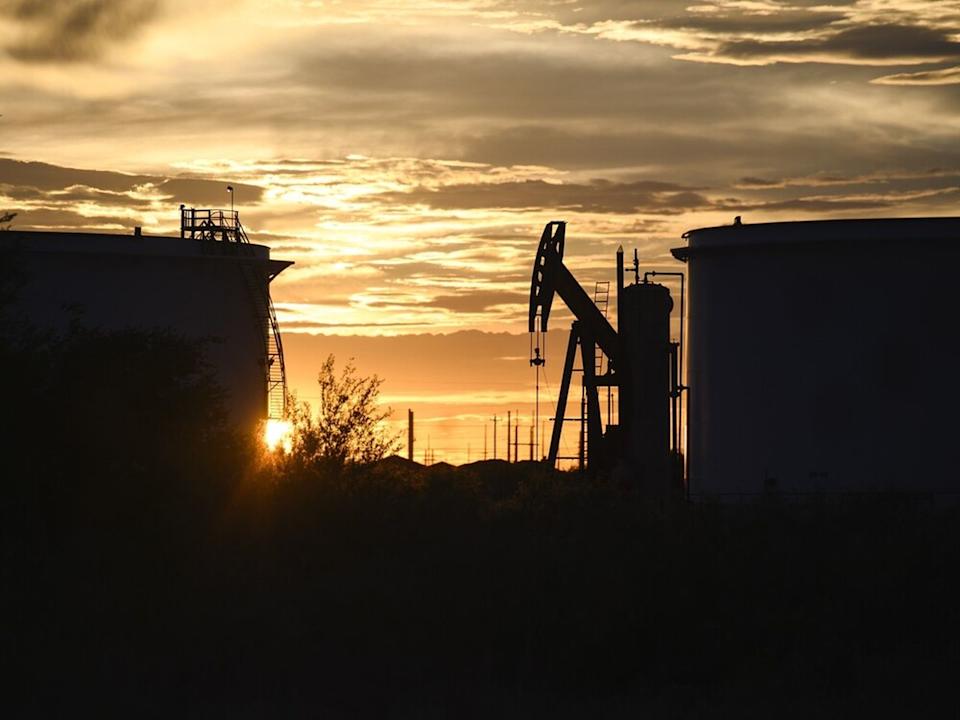
Photo caption: Crude oil tanks and a pumpjack in Midland, Texas. (Credit: Eli Hartman/Odessa American via AP files)
By Terence Corcoran:
For decades the world has been told that “peak oil” is on the horizon, a pivotal point at which the demand and/or supply of oil will stop increasing and thereby create assorted economic crises. The peak oil risk was often cited as a reason to begin cutting back on oil dependency and consumption. Via regulation and carbon taxes, the world could also reduce fossil fuel carbon emissions to help prevent the looming climate crisis and propel the global economy to net-zero carbon emissions by 2050.
In 1972 the UN forecast the peak by 2000, but as time passed and world oil output kept climbing from year to year, one prediction after another failed. Another one appears ready to collapse.
Back in June this year, the International Energy Agency (IEA) claimed that because global sales of electric cars are on course to exceed 20 million in 2025, peak oil remains “on the horizon.” All told, the IEA forecast that “global oil demand is forecast to increase by 2.5 million barrels per day (mb/d) between 2024 and 2030, reaching a plateau of around 105.5 mb/d by the end of the decade.”
Only three months later, the IEA appears to be on the brink of retreating from its June forecast, and from numerous other outlooks that have long dominated IEA thinking. Bloomberg columnist Javier Blas wrote the other day that he has seen a draft of the IEA’s upcoming annual report, which he said contains a scenario showing that if policies do not change, oil demand could rise from 105 million barrels per day (mb/d) in 2025 to 114 million by 2050, up from previous IEA outlooks that saw oil output declining to 84 million by 2050.
A revised IEA peak outlook would be consistent with comments from OPEC Secretary General Haitham Al Ghais, who argues that “oil will continue to play a vital role. Our latest review, the World Oil Outlook 2025, forecasts that demand could climb to around 123 million barrels daily by 2050.” In his view, the world’s increasing need for energy grows as economies expand and populations rise. “Oil will remain central to that.”
In another major sign of a shift in fossil fuel policy, the IEA on Tuesday released a new report warning of a lack of investment in oil and gas and calling for a major uptick in exploration, supply and production. “The oil and gas industry needs to run fast to stand still,” said the report, which added that if current levels of production are to be maintained, over 45 mb/d of oil and around 2,000 billion cubic metres of natural gas per day would be needed in 2050 from new conventional fields. That’s pretty much what Trump said: “Drill, baby, drill.”
Fossil fuel investors are gearing up. But as Bloomberg’s Blas observes, the IEA peak oil shift suggests the world is “far, far, far off” in its efforts to keep the rise in global temperatures to 1.5C above pre-industrial level as agreed under the 2015 Paris climate agreement. A new peak oil date set in 2050 would create another challenge for the United Nations’ Congress of the Parties (COP30) scheduled for Brazil in November. COP30 already appears to be on rocky ground and doomed to stumble due to a lack of global agreement on climate policies.
Prime Minister Mark Carney has been personally invited to Brazil by President Luiz Inácio Lula da Silva. At COP30, Carney can be expected to defend Ottawa’s fossil fuel and carbon policies, including expanded oil production and new pipelines.
Carney’s support for higher oil and natural gas production contradicts his previous deep commitment to climate and carbon control. Two years ago, before he turned to Canadian politics, Carney criticized the prime minister of the United Kingdom for his decision to expand oil drilling in the North Sea. According to Bloomberg News, Carney cited the International Energy Agency to say that drilling new wells in the North Sea makes no sense because the world will hit peak oil this decade.
That was then, way back in 2023. Today, Carney is all-in on growing oil production and piping it to the rest of the world. The prime minister last week declared his support for a major oil export pipeline — but under one condition: “There’ll be no oil pipeline that’s brought forward to the Major Projects Office, unless there is a decarbonization plan like Pathways.”
Pathways Alliance is an organization created by Canada’s major oilsands corporations to develop carbon capture and storage operations that would draw carbon emissions out of the projects and bury them underground. The oil companies said they were “pleased” by Carney’s reference to the Alliance and ”encouraged” that Ottawa recognizes the importance of “our proposed foundational carbon capture and storage project, and that future oil pipelines to international markets will help build Canada into an energy superpower.”
How many billions will Ottawa and/or consumers have to pay to catch and bury carbon emissions to hit peak oil? An IEA panel said governments have already invested $50 billion in experimental projects and it will now be up to the private sector to carry on.
Instead of peak oil maybe we should be getting ready for peak chaos.
=== FINANCIAL POST ===