

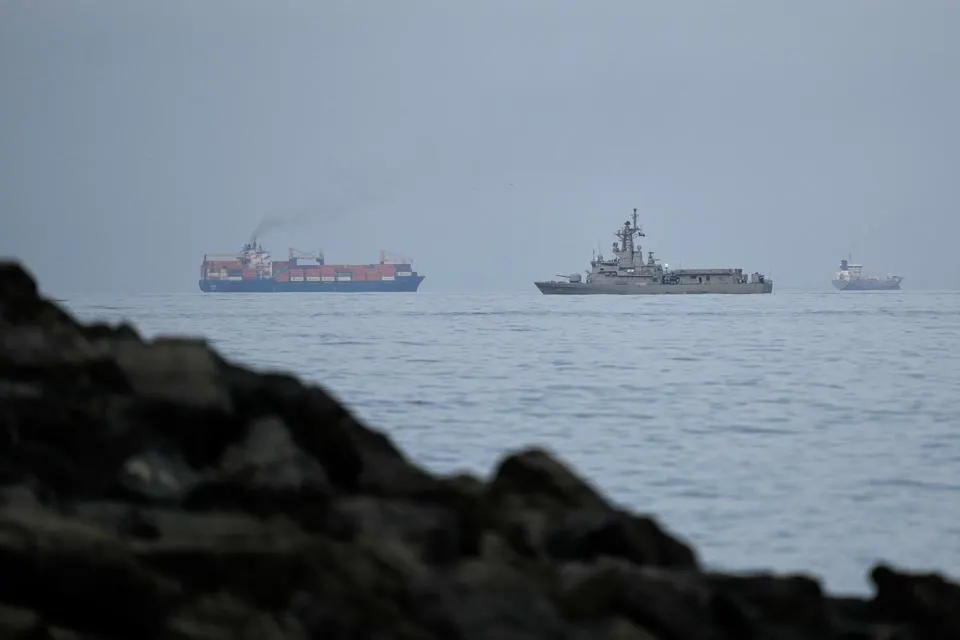
Photo caption: A UAE navy ship sails next to a cargo ship in the Strait of Hormuz as seen from Khor Fakkan, United Arab Emirates. Copyright 2026 The Associated Press. All rights reserved.
Topline
Global crude oil prices resumed their surge and crossed the $100 per barrel mark late on Wednesday night, as a global push to release 400 million barrels from strategic petroleum reserves—including a planned release of 172 million barrels from America’s strategic reserve—failed to calm market fears about the disruption caused by the Iran war.
Key facts
The global benchmark Brent Crude futures rose to $101.30 per barrel late on Wednesday, up more than 10% in the past day.
As of early Thursday morning, the index had slightly pared its gains to and slipped to around $96 per barrel.
In the past few days, the international crude index hovered around $90 per barrel after soaring to nearly $120 for the first time since 2022—as talks of a coordinated global strategic oil reserve release had briefly calmed the markets.
The U.S. benchmark West Texas Intermediate also rose more than 8.7% on Wednesday night, hitting nearly $95 per barrel, before settling at $90 per barrel on Thursday.
According to Bloomberg, the latest surge is likely a market response to Oman’s evacuation of all vessels from a key oil export terminal after two tankers were attacked in Iraqi waters.
Big number
$3.598 per gallon. That is the national average price of gasoline at the pump on Thursday morning, according to AAA’s fuel price tracker. This is a more than a 20% increase since the start of the conflict late last month.
What do we know about the IEA’s strategic reserve release?
Earlier on Wednesday, member nations of the International Energy Agency agreed to release 400 million barrels of oil from their strategic reserves. IEA Executive Director Fatih Birol said in a statement that the challenges the oil market faces are “unprecedented in scale,” adding, “Oil markets are global, so the response to major disruptions needs to be global too.” The planned release is larger than the 182 million barrels IEA members drew from their strategic reserves in 2022 after Russia invaded Ukraine.
How much oil is the U.S. releasing from its strategic reserve?
The Department of Energy announced that the U.S. would release 172 million barrels over a 120-day period as part of the IEA plan. The agency said the Trump administration has arranged to “more than replace these strategic reserves with approximately 200 million barrels within the next year—20% more barrels than will be drawn down—and at no cost to the taxpayer.” Speaking to a Cincinnati broadcaster, WKRC, Trump addressed the release saying: “We’ll do that, and then we’ll fill it up. I filled it up once, and I’ll fill it up again, but right now, we’ll reduce it a little bit, and that brings the prices down.”
Crucial quote
In its monthly oil market report, the IEA wrote: “The war in the Middle East is creating the largest supply disruption in the history of the global oil market. With crude and oil product flows through the Strait of Hormuz plunging from around 20 [million barrels per day] before the war to a trickle currently.” The agency warned that due to the challenged of bypassing the key shipping lane and limited storage, “Gulf countries have cut total oil production by at least 10 [million barrels per day]. In the absence of a rapid resumption of shipping flows, supply losses are set to increase.”
Tangent
At least two tankers were hit by explosions near the Iraqi port of Umm Qasr early on Thursday in an apparent Iranian strike, Reuters reported. CNN reported that at least one person was killed in the attack and 38 tanker crew members had to be rescued from the vessels. The United Kingdom Maritime Trade Operations center wrote that the tankers had been struck by an unknown projectile. In a separate report, the British agency, which monitors merchant shipping, said a container ship was struck by an unknown projectile near Jebel Ali in the United Arab Emirates. The strike has triggered a “small fire” on board and full damage assessment has been “impaired by darkness.” In total, at least 19 commercial ships have been damaged so far in the conflict.
=== Forbes ===